Fire Force
Helicopter Warfare in Rhodesia: 1962-1980
In December 1976, an Aérospatiale Alouette III helicopter (configured as a troop-carrying 'G-Car') was rocked by a volley of 7.62mm rounds at 800 feet as it descended towards the tree savannah of central Rhodesia. Flown by Flight Lieutenant Victor Bernard Cook, the G-Car was carrying a Rhodesian Army medic on a mercy mission to treat an African civilian, who had been wounded in a contact that morning.
The bullets, flashing up from a clearing in the trees, were fired by 27 members of the Zimbabwe African National Liberation Army (ZANLA) (supporting Robert Mugabe) whose base camp Cook was about to overfly. They severed the Alouette's tail rotor shaft and wounded Cook in the right foot and arms. His technician, Finch Bellringer, was semi-conscious after being hit by two rounds, which penetrated his body armour. The medic was mercifully unhurt but shocked.
Vic Cooke told his story to Deon du Plessis of The Star (published on 15 April 1977). Du Plessis wrote that Cooke (33) was flying with his technician and an army medical orderly to pick up African civilians who had been injured. An army patrol was with the civilians, waiting for Cook to arrive. Cook was at 1000m when his helicopter came under heavy fire. He felt some rounds hit his aircraft, and, unable to see where the fire was coming from, took evasive action, plunging down to tree level.
'I levelled off but, I was still under heavy fire. I was almost on top of them. A lot more rounds hit us. It was fierce. I felt the controls going, there was vibration. I realised I had to force land. The fire got fiercer. I picked a place to land. Then I lost tail rotor control. The chopper swung violently. It would have started cartwheeling. I pulled it up on its tail to knock off forward speed. The speed came down but we continued to yaw. Still I was quite pleased with what was happening as I had a semblance of control. I touched the power but could not hold it down on to its tail. I managed to pull the nose up a little. All the time they were still shooting. Then I saw them. I thought: “There are about as many as a rugby team”.'
Coming in for a forced landing, Cook saw a group of about five terrorists standing ahead of him shooting. Cook made his decision: 'I aimed the aircraft at them deliberately. We thumped down nose first and I lost sight of them.' As they landed a piece of the control column came off in Cook's hand. The jar of the landing jerked Cook forward. His jaw struck the top of the control stick, stunning him and cutting his chin deeply. His foot was badly gashed. Cook did not realise it and did not know how it happened. 'The engine was still running and I left it idling, hoping this would make them think we were all right.' Cook's memory was hazy. His Uzi submachine-gun had been hit and was useless. The barrel of the medic's FN rifle was bent.
'I knew the buggers were coming back. I needed a weapon. Then I saw this terr lying beyond the chopper. He may have been hit by the rotor when we came down. I don't know. But he had an AK and all I knew was he was between me and that weapon. I grabbed his AK and shot him with it. He was shouting in Shona when I shot him. I don't know what he was doing. I don't remember if we even struggled. I shouted to the medic and Bellringer: “Run for the high ground”. I ran, but then saw they were not following me. I shouted again: “Let's move!” But Bellringer said: “I can't move”.'
Bellringer had been shot while they were in the air. Together Cook and the medic dragged Bellringer to the higher ground. Cook then saw the terrorists moving in the bush 100 metres away. Cook ran forward and fired a magazine from his AK at them. 'I saw other movement and I bolted to another position and ripped off another burst.' Cook then positioned himself between the enemy and his crew. 'Then I went out further and did a few circuits of the chopper. The movement disappeared and I moved from tree to tree and rock to rock. I was in a good strong position.'
Cook was 'bloody angry' at being forced down, and wanted to pursue the terrorists. He kept tripping, however, and only then did he see the deep gash in his foot. He could see the bone. 'After that I didn't feel so aggressive,' he said. He helped the medic erect a drip stand on the wounded technician. Of the medical orderly, Cook said 'He was a star. At no stage did he abandon his patient.'
The Rhodesian Army unit, which had called Cook from Rutenga (in south-eastern Rhodesia) was close by and heard the crash and the firing. It summoned help. Fifty minutes later a Reims Cessna FTB 337G 'Lynx', twin-engined light aircraft, arrived overhead, to be followed shortly by the Fire Force. Cook and his crew were evacuated by helicopter and a follow-up on the tracks on his attackers was instituted. Cook recalled: 'There were four brown jobs. They were a beautiful sight.' Cook was awarded the Silver Cross but said he did not believe that he deserved it. 'Not when you see what the browns do. Those RLI guys, they are all Silver Cross material.'
For his gallantry, Victor Cook was awarded the Silver Cross of Rhodesia.
Flying the helicopter came later in the life of the always small, if potent, Rhodesian Air Force. When the helicopter was adopted, its agility - its ability to hover, to land and take-off in almost impossible terrain - was exploited to the full by the Rhodesians in their counter-insurgency war. Indeed the Rhodesians were to produce a unique and deadly variant of the tactic of 'vertical envelopment' of a target by helicopter-borne infantry, which they called 'Fire Force'.
There was nothing new in the military use of helicopters. As soon as helicopters were available, the air forces and armies of the world gave them a multitude of tasks. The first workable machines appeared in the Second World War - the American Sikorsky R-6A and the German Flettner F1 282 Kolibri. Helicopters found general use thereafter. They were used for casualty evacuation in Korea and for moving forces to combat insurgents in Malaya, French Indo-China and in Kenya. In Algeria, the French developed the use of armed helicopters, the first 'gunships' (armed Alouette IIs) working with parachute troops and helicopter-borne infantry (carried in American Vertol H-21 twin rotor helicopters) to isolate and eliminate insurgent units.
There was a clear need for helicopters in Rhodesia but almost all of the terrain was over 2,000 feet above sea level and the climate was hot. As height and heat drastically reduced the efficiency of helicopter engines, a special helicopter was required. Such a helicopter was to be developed by the French who took the lead early on in the race to design light turboshaft engines.
The man of vision in France was Joseph Szydlowski, who founded the Société Turboméca in 1938 and worked on small gas turbines throughout the Second World War despite Nazi occupation of his factory. By 1949, he produced the Artouste Mark II gas turbine, which produced 400-shaft horse power (shp) and, at 253 lbs, weighed less than half than any equivalent piston engine. The American Boeing Company was working on gas turbines and one powered the first gas-turbine helicopter in the world, the Kaman K-225 twin-rotor 'egg-beater' of the US Navy, which flew on 10 December 1951. Boeing, however, soon lost interest and left the field to the French.
In 1953, the Artouste Mark II replaced the radial piston engine of the small crop-spraying helicopter, the Sud-Aviation (later Aérospatiale) SE3120 Alouette [Lark]. This gave it such a unique performance that Société Turboméca became the leading supplier of small turbine helicopter engines in the western world.
The Alouette II had an open girder frame, an exposed engine, a skid landing gear and a bubble canopy. Aside from the pilot, it could carry four passengers, or two stretchers and two sitting wounded, or a 1,100 lb load - either in a sling under the fuselage, or in the form of guns, missiles or homing torpedoes. In June 1955, this little helicopter set a new world height record by climbing to 26,932 feet and found a ready market in 33 countries.
Turboméca's next jet engine, the Astazou (derated from 530 to 350 shp) gave constant power under any conditions of height and hot climate. It doubled the load-carrying capacity of the Alouette II and led to even wider sales. The Indian version, the HAL Cheetah, landed and took-off at heights above 24,600 feet in the Himalayas. In June 1958, the Alouette II set a height record for helicopters at 36,037 feet.
The arrival of the even more powerful Artouste engine (derated from 870 to 570 shp) resulted in the bigger Alouette III, which first flew on 28 February 1959 and was soon performing spectacularly. In June 1960, it landed and took-off with seven people on board at an altitude of 15,780 feet on Mount Blanc in the French Alps. In November 1960, carrying two crew members and a 550 lbs load, it landed and took-off at an altitude of 19,698 ft. This was unprecedented in the world of helicopters.
The Alouette III SA316B could accommodate the pilot and six fully equipped troops. The Rhodesian practice was to carry a technician and four troops and to mount a FN 7.62mm MAG machine-gun [after 1976 twin Mk 2 .303-inch Browning Mk2 machine-guns - the RAF's turret and wing guns of the Second World War] at the port rear door. The passenger seats were easily removed, allowing the carriage of a variety of different loads. Experience in combat led the Rhodesians to remove the doors and to reverse the front passenger seats to widen the available floor space and gain flexibility. Casualties could be put on the floor. It was easier to leave the helicopter quickly and more could be carried. There was provision for an external sling for cargoes weighing up to 1,650 lbs (750 kgs). A hoist could be fitted with a 380 lbs (175 kgs) capacity to allow casualties and other loads to be winched up. The Alouette III could carry two stretcher cases and two seated wounded.
Produced after first flying on 27 June 1968 and exported after 1970, the SA319B Alouette III was powered by the Astazou XIV (derated from 870 to 600 shp), which was even more effective in 'hot and high' conditions and more economical. The SA319B had strengthened main and tail rotor transmissions. It weighed slightly more but could carry a heavier payload.
The Alouette III SA316B had a maximum speed of 124 mph at sea level and a cruising speed of 115 mph. The Alouette III's service ceiling was 13,100 feet and it had a hovering ceiling in ground effect of 9,450 feet. Out of ground effect, the hovering ceiling was 5,000 feet. Its range at optimum altitude is given at 335 miles. SA319B had a slightly longer range. In practice, these ranges were considerably shorter. Under Rhodesian conditions, when loaded with troops, the Alouette would fly at 65 knots (or 75 mph) and, with a light load, at 84 knots (or 97 mph). At 84 knots, its range was 242 miles (210 nautical miles). The Alouette III SA316B 'K-Car' gunship, armed with a 20mm cannon and ammunition, and a crew of three, would have an endurance of an hour and a quarter to an hour and a half when loaded with 600 lbs of fuel. The Alouette III SA316B troop-carrying 'G-Car' with 400 lbs of fuel, a crew of two and four fully equipped troops had an average endurance of forty-five minutes.
The Alouette III is a magnificent military machine, capable of being operated well beyond what its designers expected. It uses jet fuel (paraffin) but can operate on diesel - and petrol in a dire emergency [and only for a short flight]. It is capable of absorbing astonishing quantities of small arms fire and even hits from anti-tank rockets. An Alouette III, flown by Ted Lunt and carrying Major Pieter Farndell of Support Commando, Rhodesian Light Infantry, was hit in the tail section by an RPG7 rocket and still brought them home safely. On 14 October 1978, Dick Paxton's Alouette III, with Major Nigel Henson (also of Support Commando) aboard, was riddled by small arms fire when Paxton flew it slowly at a low altitude over a hidden insurgent camp. Paxton was caught like this because of confusion over an incorrect map reference supplied by the personnel of an observation position (OP) overlooking the camp. With all instruments shattered and a blade punctured, Paxton was still able to climb to his operational height, 800 feet, orbit, and put down suppressive fire, before flying out. The celebrated pilot and, later, Selous Scout, Michael Borlace, brought an Alouette III home to Fort Victoria airfield with tail rotor control failure and landed it without harm to its crew and its complement of black soldiers. As has been seen, Flight Lieutenant Victor Cook was able to land his Alouette even after its tail rotor drive shaft had been severed. The impression must not be given, however, that the Alouette was invulnerable because a hit in the engine or the main rotor gearbox could be fatal.
Both versions of the Alouette III were bought by Rhodesia while finding favour in 68 other countries. How many of each type Rhodesia possessed has not been revealed. Given international sanctions as a consequence of the unilateral declaration of independence by Ian Smith on 11 November 1965, clarity of records cannot be expected. It is known that:
3 were acquired in April 1962 (1 damaged beyond repair: on 17 January 1972)
2 were acquired in July 1962
3 (with hoists) in August 1963
4 were acquired in August 1968 (2 damaged beyond repair: on 1 July 1970 and 20 November 1973)
1 were acquired in April 1972 (1 damaged beyond repair: on 17 March 1977)
5 were acquired in December 1972
2 were acquired in January 1974
1 were acquired in July 1974
2 were acquired in January 1975
2 were acquired in March 1975
4 were acquired in June 1975 (1 shot down: on 18 May 1977)
1 were acquired in February 1977
5 were acquired date not known
3 were acquired in June 1979
12 were acquired date not known
There were many more helicopters brought down by fire from the ground than the above list indicates and many were re-built. In fact, all Alouettes are rebuilt totally in the course of their preventive maintenance cycle. The engine would be changed after 1,200 flying hours and the airframe after 3,600. In the difficult times after 1965, many helicopters were built entirely from spares.
This list gives a total of 50 Alouettes but how many were actually owned by Rhodesia and how many were on loan from South Africa is not clear. At one stage, 27 South African helicopters were deployed in Rhodesia. Within No. 7 (helicopter) Squadron, the South African Alouettes were designated as belonging to Alpha Flight. In 1980, when Rhodesia had become Zimbabwe, the Air Force of Zimbabwe was left with eight Alouettes, which gives some indication of its true strength.
By deft evasion of the international sanctions and the consequent arms embargo, eleven Italian Agusta-Bell 205A (the Rhodesians called them, 'Cheetahs') were acquired in August 1978. The AB205A was the celebrated American 'Huey' of Vietnam fame built under licence in Italy with a range of 400 kilometres and a maximum speed of 126 miles per hour. It was designed to carry 11 passengers but because these particular AB205As were elderly, and after armour and twin .303-inch machine-guns had been fitted, they could transport eight troops. Thus, they had a greater range and double the carrying capacity of the Alouettes. In 1979, the use of the 205As on external operations into neighbouring countries meant that the Fire Forces engaged in internal operations were not constantly robbed of their Alouette IIIs. This allowed the creation of large 'Jumbo' Fire Forces, which contributed, to the increased casualties inflicted on the insurgent forces.
The purchase and immediate fate of the Rhodesian AB205As before they arrived in Rhodesia is not clear. They came to Rhodesia via the Comoro Islands, a common route for embargoed items. It is believed that a customer in Kuwait ordered thirteen AB205As from Agusta in Italy. They were delivered by ship in Beirut, were unloaded and moved to Kaslik, a Maronite suburb of Beirut. Then they were bartered for arms from Israel for Major Haddad's Christian militia in southern Lebanon. The Rhodesians were led to believe that they had purchased new aircraft but the AB205As they received were beyond their safe flying life. With vital parts corroded, the Rhodesians had a major task in restoring the aircraft to a flying condition. Early in their operational life, one AB205A was lost when its tail rotor sheared on 12 February 1979 but otherwise they were to make a significant contribution to the counter-insurgency operations.
The importance of helicopters to Rhodesia was such that, when its counter-insurgency war was at its height, No. 7 Squadron was the largest squadron in the world with 40 Rhodesian pilots and some 20-seconded South African Air Force pilots, flying 45 aircraft. Pilots served three-year tours on the different aircraft types of the Rhodesian Air Force. When, because of political pressures, South African pilots were withdrawn, the loss was made up by seconding senior qualified personnel from headquarters (after a five-hour re-familiarisation course) and by calling up former pilots who had returned to civilian life. The Rhodesian Air Force might have been of excellent quality but it was always the smallest of the Rhodesian units. Its greatest strength in the 1970s was only ever 2,300 personnel (150 of them pilots) and including the General Service Unit, which was deployed to guard its installations.
The birth of Rhodesia's air force was unintentional. In the mid-thirties, when the re-emergence of a German threat to peace caused nations to re-examine their defences, the members of the Legislative Assembly of Southern Rhodesia did likewise. In a gesture of loyalty, they offered Britain £10,000 for the Royal Navy to strengthen imperial defence. They were not expecting the British to respond with the suggestion that Southern Rhodesia should establish an air-training unit. This illustrated the unique position of the Colony of Southern Rhodesia in the British Empire because, not only was she self-governing, but she had the right to defend herself despite not having the status of a dominion and therefore sovereignty. As external threats hardly existed, defence was left to the only regular force in the colony, the British South Africa Police (BSAP), reinforced by the part-time white territorials of the Rhodesia Regiment and district rifle platoons.
The air-training unit, placed under command of the Rhodesia Regiment, sent the first six trainee pilots for instruction at the local flying school run by the de Haviland Company at Belvedere Airport, Salisbury [now Harare], in November 1935. They trained on Wednesday afternoons and weekends in Gipsy Moths and Tiger Moths. By 1937-1939, the unit had a new airfield, at Cranborne in the southern outskirts of Salisbury, and 15 biplanes - six Hawker Hart bombers, six Hawker Audaxes two-seat army co-operation aircraft and three Gloster Gauntlet single seat fighters.
The imminence of war led to the mobilisation of the Air Unit and on 28 August 1939, Southern Rhodesia was the first in the British Empire to send her servicemen abroad. Two flights of Harts and Audaxes took off for Kenya to replace No. 233 Squadron of the Royal Air Force, which had departed for the Sudan. Again, Southern Rhodesia had demonstrated her loyalty to Britain and would remind Britain of this when relations soured twenty years later.
On 19 September 1939 the Air Unit was renamed the Southern Rhodesian Air Force with its three flights in Kenya becoming No. 1 Squadron. Southern Rhodesia also formed the Rhodesian Air Training Group to train British aircrew under the Empire Training Scheme, building training establishments outside Salisbury, Bulawayo and Gwelo [now Gweru], which produced 2,000 pilots and 300 navigators for the Royal Air Force.
In 1939, the 69,000 whites in Southern Rhodesia were able to spare 10,000 men and women for war. To avoid devastating casualties, major Rhodesian units, with the exception of the Rhodesian African Rifles (RAR), were not sent abroad. Instead, Rhodesians were seconded to the South African and British services. On 22 April 1940, No. 1 Squadron of the Southern Rhodesian Air Force was absorbed by the Royal Air Force as No. 237 (Rhodesia) Squadron. Two other Royal Air Force squadrons, No. 266 and No. 44 had 'Rhodesia' added to their titles. 977 Rhodesian officers and 1,432 airmen served in the Royal Air Force with 579 becoming casualties and of those 498 died. Rhodesian airmen won 256 medals. One member of No. 237 (Rhodesia) Squadron was Ian Douglas Smith, later the Prime Minister.
The end of the war and demobilisation left Southern Rhodesia with only two regular defence units, the RAR and the Permanent Staff Corps, which supplied the instructors for the compulsory territorial service which young white males underwent in the Rhodesia Regiment, attending short camps and weekend parades. Within the Staff Corps, however, there were airmen fresh from war, and their enthusiasm led to the revival of the air unit and, then, in 1947, to the re-establishment of the Southern Rhodesian Air Force (SRAF). Its strength was 69 officers and men, flying North American Harvard advanced trainers acquired from the South African Air Force and the Royal Air Force. In 1948, Field Marshal Smuts, the Prime Minister of South Africa, donated a Douglas C47 Dakota. In 1951, 22 Supermarine Spitfire Mark XXIIs were acquired to be flown by short-service officers and part-time pilots. In 1952-1953, the SRAF entered the jet age, re-equipping with sixteen de Haviland Vampire FB9 fighter-bombers, sixteen Vampire T11 jet-trainers and sixteen Percival Provost T52 piston-engined basic trainers.
Again, the money for these aircraft had come from a loyal gesture. The Imperial defence authorities had informed the Southern Rhodesian Government that, without jet aircraft, the SRAF was useless for defence of the Empire and should be disbanded. Southern Rhodesia was, as ever, short of money, so the long-serving Southern Rhodesian Prime Minister, Sir Godfrey Huggins, turned for help to his future partner in the coming Federation of Rhodesia and Nyasaland, Roy Welensky, the Leader of the Unofficial Members in the Northern Rhodesian Legislative Council. Not wanting to lose the SRAF and knowing that re-equipment was inevitable once the Federation was in being, Welensky persuaded the Northern Rhodesian Government to meet the bill of £200,000.
The British sanction of the formation of the Federation of Rhodesia and Nyasaland - an unlikely marriage of a self-governing colony with two protectorates - was the product of a sustained campaign by Roy Welensky and Godfrey Huggins, both of whom hoped to create a great British dominion north of the Limpopo. Although the Federation did not gain sovereign status, it inherited Southern Rhodesia's right of defence and took over the SRAF and the army units of the three territories. The Queen granted the title 'Royal Rhodesian Air Force' (RRAF) and khaki army uniforms and rank structures were exchanged for British style Air Force blues and ranks.
In 1956, the RRAF comprised No. 1 and No. 2 Vampire squadrons; No. 3 transport squadron, with eight C47 Dakotas and two Percival Pembroke light transports; and No. 4 training squadron, with Provosts. The air station at Thornhill was acquired from the departing Royal Air Force and was modernised. The Federation undertook to supply infantry and air force reinforcements to the British Middle East Command as its contribution to Commonwealth defence. Consequently, in 1959 it bought four Canadair C4 transports and fifteen English Electric Canberra B2 light bombers. In 1958, the Vampire squadrons helped the Royal Air Force deal with dissident tribesmen in the Aden Protectorate. In 1961, Rhodesian transport aircraft supported British forces in the Kuwait crisis and dropped food in a flood-relief operation in Kenya. In 1959-1963, the Canberra squadrons regularly reinforced the Royal Air Force in Cyprus. In 1963, the front-line strength was enhanced when No. 1 Squadron re-equipped with twelve Hawker Hunter FGA9 ground attack fighters. The RRAF remained small but justly proud of its efficiency. While the Royal Air Force needed a ratio of 300 men per jet aircraft, the Rhodesians could achieve a better rate of serviceability with only 30 men per aircraft.
The role of the RRAF by then was not an entirely external one. From 1956, onwards the Federal forces began to concentrate on internal security operations. In response to awakening African rejection of white rule and the British and French retreat from empire, the RRAF formed No. 6 Squadron, equipped with Provosts, for an internal security role
There were clear signs of strengthening African nationalism in all three territories of the Federation. In 1957, there were riots in an African township in Salisbury. In 1958, Dr Hastings Banda returned from abroad to lead the African resistance in Nyasaland and would by 1962 convince the British that the Federation could not endure and that Nyasaland had to secede. Applying equal pressure was Kenneth Kaunda in Northern Rhodesia. After 1957, the African nationalists in Southern Rhodesia, with Joshua Nkomo taking a prominent role, became more militant. In February 1959, the RRAF's No. 3 Squadron flew troops from Southern Rhodesia to quell unrest in Nyasaland. RRAF Provosts flew in support of the police and troops, dispersing crowds with air-delivered tear gas canisters, dropping leaflets and undertaking reconnaissance. Vampire jets flew 'showing the flag' flights, as did the new Canberra bombers. Belgium's sudden decision in 1960 to withdraw from the Congo, creating Zaire, brought mutinies, insurrection and the Katanga crisis. The Federal Army was deployed to the Northern Rhodesia northern border while the RRAF protected Federal airspace and flew out of the Congo over 2,000 whites refugees, fleeing the violence.
Experience in Nyasaland highlighted the need for rapid reinforcement of troops. The feasibility of the use of paratroops was examined in March 1960 when the RRAF adapted Dakota aircraft for tests. The acquisition of helicopters was considered but the contemporary helicopters were useless in the Federation's 'hot and high' conditions. The Alouette III helicopter was not yet available.
Then, on 9 May 1960, in a review of Imperial defence, the Chief of Imperial General Staff, Lord Louis Mountbatten, suggested to Welensky (then the Federal Prime Minister) that the Federal contribution should be reduced from an infantry brigade to a squadron of SAS parachute-trained Special Forces, providing the Federal Army with its paratroops. The mutinies of black soldiers in the Congo in the next month encouraged the Federal Government to establish white professional army units - C Squadron of the SAS, the First Battalion of the Rhodesian Light Infantry (1RLI) and an armoured car squadron - as insurance. The Territorial Army was expanded, with reserve battalions increasing the number of the Rhodesia Regiment battalions to ten. The BSAP recruited a police reserve of 30,000 whites and blacks. The RRAF formed a parachute school to train the SAS and created the Volunteer Reserve to tap the skills of the civilian population. It ordered Alouette III helicopters, choosing them not only because they suited local conditions, but also because their price suited the Federal Treasury. The Alouette III was also the choice of the South African Air Force, which meant that training facilities and expertise could be shared. The Portuguese Air Force had also purchased Alouette IIIs and would be the first to use them with French 20mm cannons.
This strengthening of forces was also in response to the increasing African nationalist sponsored unrest in all the territories and in Southern Rhodesia in particular. The emergence of the militant Youth League in 1957 gave black resistance a new edge. In February 1959, the Southern Rhodesian Government responded with a state of emergency, designed to crush resistance quickly so that troops could be released to deal with Banda in Nyasaland. By then the British Prime Minister, Harold Macmillan, had decided to speed up the decolonisation process dramatically and seek Britain's future in Europe. Nyasaland and Northern Rhodesia were moved rapidly towards independence while in 1961 Southern Rhodesia was given a new constitution, designed to give blacks an enhanced political role and eventual domination. The Southern Rhodesian Prime Minister, Sir Edgar Whitehead, had in fact been seeking quasi-dominion status but the British Government was in no mood to give the whites - less than five per cent of the population - perpetual political domination. If Southern Rhodesia were to become an independent sovereign nation, she had to accept rule by the majority. While the whites rejected this, it encouraged black resistance. The National Democratic Party demanded power and persuaded its leader, Joshua Nkomo, to reject the new constitution.
Whitehead attempted to meet black aspirations with a number of reforms of racial legislation but when he threatened to deal with the fundamental black grievance, that of the unequal racial allocation of land, the white electorate ousted him in the general election of 1962. He was succeeded by the Rhodesian Front led by Winston Field who promised not to tamper with land tenure and to secure independence at the demise of the Federation in the next year. Field did not deal with the land issue and he failed to secure independence. His party replaced him in 1963 with Ian Smith. British intransigence on the independence issue led Smith to declare Rhodesia independent on 11 November 1965.
Black resistance in Southern Rhodesia had led Whitehead to strengthen the police force, to ban the National Democratic Party (only to see it replaced instantly by the Zimbabwe African People's Union (ZAPU)) and to introduce security legislation. The African nationalists countered with urban unrest - riots, strikes and the like. The favoured weapon was the petrol bomb aimed mostly at blacks collaborating with the whites. In addition, in 1962, the African nationalists decided on an armed struggle and sent young men for training in Ghana, Tanganyika and at insurgency warfare schools in Russia and its satellite countries. In addition, in 1962, the police began to uncover arms caches. Over a thousand African nationalist supporters were arrested and Whitehead banned ZAPU. African nationalists set fire to forests at Chipinga on the eastern border and the SAS parachuted in to deal with them.
Thus the war of liberation, known as the 'Chimurenga', began in late 1962. The pattern of urban violence continued for a year or more and then fizzled out because of good police work and the effectiveness of the law. The African nationalists split into two factions, the ZAPU led by Nkomo, and the Zimbabwe African National Union (ZANU) led by the Reverend Ndabaningi Sithole (later to be ousted by Robert Mugabe), and established themselves in sympathetic Zambia across the Zambezi. From there, from 1966 onwards, they sent men into Rhodesia to foster rebellion in the urban and rural areas. The towns remained unco-operative but the rural areas began to harbour the insurgents in 1972 when the success of FRELIMO rebels in Mozambique provided the Rhodesian African nationalists with safe havens and supplies close to the border.
Internal security was a responsibility of the police who were assisted by the Army and the RRAF. The new No. 7 Squadron, equipped with the Aérospatiale SA316B Alouette IIIs, was able to insert personnel quickly to precise points and rescue the stranded and the injured. Three Alouettes arrived in April 1962, two in July and three in August 1963. As soon as the first two pilots, trained in France and South Africa, were on strength, they were sent to fly over the townships, dropping leaflets and tear-gas grenades on rioting crowds (only rarely), 'sky shouting', acting as airborne and command posts, and generally assisting the police. As pilots only have time to listen to snappy, brief transmissions, the police and army were forced to revise their ponderous radio procedures.
In the division of assets at the break-up of the Federation in 1963, the RRAF was returned to Southern Rhodesia with all its aircraft except for three transport aircraft, which were given to Zambia. By then, the RRAF had 1,200 regulars including a General Service Unit of black soldiers for guard and transport duties. Some adjustments were made. The Argonauts were sold, as were some Canberras and Vampires. No. 6 Squadron (then a Canberra squadron) was disbanded and its aircraft went into storage.
At the time of UDI in 1965, the RRAF had concentrated at two bases - New Sarum near Salisbury and Thornhill near Gwelo.
New Sarum housed the administration, the photographic and the air movements sections, the aircrew selection centre, the apprentice training school and the parachute training section. Its air units were No. 3 Squadron (transport), No. 5 (bomber) with Canberras and No. 7 Squadron (helicopter) with Alouettes.
Thornhill had No. 1 Squadron (fighter) with Hunters, No. 2 Squadron (fighter) with Vampire FB9s and No. 4 Squadron (flying training) with Provosts. The trainees first flew Provosts and then Vampire T11s before flying the Vampire FB9s on armament training.
Thereafter all pilots rotated through the squadrons, learning to fly a variety of the aircraft on strength. This gave the RRAF pilots considerable versatility. They would serve tours on helicopters, ground attack aircraft, fighters, or transports before becoming instructors. The types they flew depended on the pilot's nature. The more sedate pilots would fly transports and the Canberra bombers while the more aggressive would be posted to the fighters. Pilots would serve two tours with the squadrons before they were posted on their instructors courses, flying Provosts on basic flying training for a year or two before going on to jet instruction or taking up instructors' posts with the squadrons.
Facing little external threat, the first challenge facing the RRAF (which in 1970 would drop 'Royal' from its title when Rhodesia became a republic) was how to procure spares and aircraft in defiance of international sanctions. This was met with ingenuity and subterfuge. The jet engines were a particular challenge as, prior to 1965, they had been sent to Rolls Royce in Britain for servicing. The Unilateral Declaration of Independence on 11 November 1965 prompted the British to seize fourteen Avon Series 207 engines being serviced for the Rhodesian Hunters and Canberras. This loss forced the Rhodesian Air Force technicians to service and maintain the remainder of their engines and equipment themselves with the help of local industry. Difficulties in procuring starter cartridges led to the discovery that the Canberra engines would start on compressed air and a truck's starter motor could replace the cartridge starter in the Provost. After 70 starts, the starter motors for the Hunters had previously been sent back to Rolls Royce for servicing at a cost of £14,000 per motor. The RRAF technicians taught themselves to strip down the starter motors and service them at a cost of 76 pence per unit! That nine of the twelve Hunters were still flying 16 years later was a measure of their success. By dint of subterfuge, Rhodesia bought from Belgium 42 Avon 207 jet engines in 1966 and ten years would later acquire more from Oman where they had been buried in sand. Spares and weapons were secured through clandestine purchasing and local manufacture - including the production of a singularly lethal range of aircraft bombs - the Frantan, Alpha and Golf.
While jet fighters and bombers could not be purchased and had to be repaired, it was possible to replace the light aircraft. In August 1967, No. 6 Squadron was revived to take over No. 4 Squadron's role of basic flying training with seven Provosts. No. 4 Squadron re-equipped with ten new Aermacchi AL60-B2Ls for the counter-insurgency role. Assembling them themselves, the Rhodesians called the AL60-B2Ls, 'Trojans', to confuse the outside world. In fact, 28 refurbished North American T28 'Trojans' had been bought from France in 1966-1967 but the ship carrying them had turned back within sight of Cape Town when the United States Government threatened to revoke all manufacturing licences held by the French. In January 1976, the Aermacchi AL60-B2L Trojans were replaced by 21 Reims Cessna FTB 337G Lynxes, twin-boom, twin piston-engined light attack aircraft. In 1977, 31 SIAI Marchetti SF260 Genets were bought to replace the Provost trainers of No. 6 Squadron and to provide more light attack aircraft. In 1976 six Britten-Norman BN-A Islanders were obtained for No. 3 Squadron to join additional Dakotas, a Cessna 421A and a Beech 95 C-55 Baron. In 1978, a new Squadron, No. 8, was created to fly the eleven Agusta Bell 205A Cheetah helicopters.
Time caught up with the Canberras and the Vampires and they became dangerous to fly. A Canberra B2 was re-built from spare parts and the South Africans passed on surplus Vampire FB52s and T11s. In the mid-seventies, when the T11s were beyond repair, South Africa set up a flying school in Durban where young Rhodesians flew Impala jet trainers. In addition, when needed, the South Africans would reinforce the Rhodesian Canberra force with Canberra B12s of their own. The South African contribution included building two advanced airfields, capable of handling jet aircraft, at Wankie, just south of Victoria Falls, and at Fylde, near Hartley west of Salisbury. These bases were intended to provide for joint Rhodesian, South African and Portuguese defence. More important was South Africa's helicopters and crews. These were sent into Rhodesia to support the South African Police units, which served in Rhodesia between 1967-1975 or were seconded to the Rhodesian Air Force (RhAF) as Alpha Flight or were allowed to 'join' the RhAF for tours of duty. Some South African aircrew did tours as long as three years. When major cross-border operations were being mounted, such was the co-operation with the South African Air Force that the Rhodesians could field 50 helicopters.
The South African helicopter force was, however, a double-edged sword on occasions. The South African Prime Minister, B.J. Vorster, used it to apply political pressure on the Rhodesian Government. In 1976, for example, when he was seeking to coerce Ian Smith into accepting majority rule, Vorster withdrew 27 pilots on the pretext of protesting at the escalation of the Rhodesian war, represented by the raid by the Rhodesian Selous Scouts on an insurgent camp at Nyadzonya in Mozambique on 8 August. Vorster also cut off Rhodesia's supplies of ammunition and fuel, forcing Ian Smith to accept the settlement proposals offered to him in September by the US Secretary of State, Henry Kissinger. Once Smith's acceptance of majority rule had produced the first African dominated government, that of Bishop Muzorewa, the South African support was liberally renewed with, amongst other aid, two South African-manned Fire Forces being established in the south of Matabeleland, with four South African Aérospatiale Pumas each. The troops were South African Parabats (paratroopers) with Rhodesian pilots and army personnel assisting.
When the RhAF required long-range transports for cross border operations, it borrowed them from the commercial airline Air Trans Africa whose owner, Jack Malloch, was an officer in the Volunteer Reserve. Many vital spares were brought in by Malloch who ran a sustained exercise in the evasion of sanctions. Other members of the Volunteer Reserve were used to staff forward airfields (FAFs) in the operational areas, established once the insurgency became a fact of life, to provide air support for the ground forces. Eventually there were nine such bases: FAF1 (Wankie); FAF2 (Kariba); FAF3 (Centenary); FAF4 (Mount Darwin); FAF5 (Mtoko); FAF6 (Chipinga); FAF7 (Buffalo Range); FAF8 (Grand Reef); and FAF9 (Rutenga). In addition, impromptu FAFs would be created, as needed, anywhere there was a 1,000-yard runway.
It was from the FAFs that the helicopters and aircraft assigned to 'Fire Force' operated. Thornhill and New Sarum provided facilities for major maintenance and repair but the helicopter units of four to six aircraft were mostly self-sufficient because each helicopter crew comprised a pilot and a qualified technician who maintained the aircraft as well as manning its machine-guns or 20mm cannon. The jet squadrons based at Thornhill and New Sarum, being in the centre of Rhodesia, were able to provide quick response anywhere when a target tough enough to need the attention of Hunters and Canberras presented itself.
The helicopter has unique features to offer the military. Under anything but truly abnormal conditions, helicopters can ascend or descend at steep angles, allowing them to operate from confined and unimproved areas such as forest clearings, narrow valleys etc.
Although the French had designed the Alouette II and III as purely clear weather daylight machines and therefore had not fitted the necessary night flying equipment, the Rhodesian pilots would fly at night if they could see the horizon. Their take-offs and landings required only minimum illumination. The ability of the helicopter to fly at high or low altitudes and to decelerate rapidly, combined with the capacity for slow forward speed and vertical landing, allows it to be flown under marginal weather conditions.
The insistence on a minimum horizon was the product of an accident, which killed Air Lieutenant G. Munton-Jackson and his technician, Flight Sergeant P.J. Garden, on 17 January 1972. Before that, pilots had flown in the dark, virtually without instruments - the French had fitted an E2A as the principal compass. In other aircraft, the E2A was a standby device. The lack of direction finding equipment had led to Peter Petter-Bowyer in 1969, when flying a load of ammunition and weapons before dawn from Thornhill, Gwelo, to Binga, on the Zambezi River, to stray north-west into Zambia. Low on fuel and lost, Petter-Bowyer landed next to a farm, near Livingstone, to ask where he was. An African enlightened him but did not tell him that he had landed next to ZAPU's base at 'Freedom Farm'. This Petter-Bowyer did not discover until he had landed back in Rhodesia at the Victoria Falls and was told so by Air Vice-Marshal Harold Hawkins, the Commander of the Air Force. The net result was that the Alouettes were fitted with Becker radio direction finders. Munton-Jackson was flying one of a pair of Alouette IIIs en route from New Sarum, Salisbury, to Thornhill. The Alouettes were caught in a heavy thunderstorm and an attempt was made to bring them in on a radar approach. One Alouette succeeded but Munton-Jackson crashed. It was not known whether he became disorientated but it was decided that henceforth the helicopters would only fly when a horizon could be discerned. The pressure of the war would lead to that ruling often being ignored. In the interests of safety, the officers commanding No 7 Squadron made every effort to enforce the ruling but precedents had been set and it was difficult to convince the ground forces that a casualty evacuation or other such requirement was impossible because of the lack of a horizon. Pilots found themselves in difficult and invidious positions but, as the war progressed, they began to transgress the rule less and less. They were so often in danger that they could not be persuaded to take even greater risks.
The wide speed range and high manoeuvrability at slow speeds enables helicopters to fly safely at low altitudes using hills and trees as cover. In low intensity warfare - where there are no front lines - the choice can be made of the most concealed line of approach to the enemy. The noise of the engines will alert him, but the reflection of the sound of low-flying helicopters can deceive him as to the direction being taken. Helicopters can achieve surprise through 'contour-flying' (flying just above the tree-tops, following the contours of the land). They can confuse by using 'dummy' deployments of infantry stop-groups, and can, as the Rhodesians showed, employ a shock effect by putting down lethal fire.
The Alouette III lacked the aerobatic capabilities of more modern helicopters. Nevertheless, a Rhodesian Alouette, configured as a gunship or 'K-Car', flown by Charles Goatley, with Beaver Shaw manning the 20mm cannon, had the distinction of shooting down a Botswana Defence Force Islander on 9 August 1979. This happened when Goatley was covering a recovery by helicopters of troops from an external operation against a Zimbabwe People's Revolutionary Army (ZIPRA) base at Francistown.
Noise, however, was a constant problem in giving away the approach of an attacking force. On 5 February 1979, during Operation Dabchick, a raid on Mucheneze Camp across Rhodesia's south-eastern border in Mozambique, the SAS call-sign watching the camp heard the approaching AB205A Cheetahs eight minutes before they arrived. The Rhodesians also often flew the noisy Aermacchi AL60-B2L Trojans ahead of the Fire Force to mask the whine of the helicopters. Peter Petter-Bowyer did this when leading Fire Force to camps, which he had discovered through his aerial reconnaissance. On Operation Dingo in November 1977 a DC8 jet airliner was flown over ZANLA camps near Chimoio an hour before the airstrike, which opened the attack on them. ZANLA were holding their muster parade, and, as expected, took cover at the sound of the DC8. They returned to the parade ground and did not disperse when they heard jet engines again because they assumed that the DC8 was returning. What they heard was the sound of Hunter ground attack fighters diving out of the sun and the approach of a small armada of Alouettes. Crucial factors with regard to masking noise were terrain and wind direction. An approaching Fire Force would plot its flight to the target with these in mind. In 1979 a Fire Force would fly from Centenary in a southerly half-circle - having to refuel on the way - to attack targets in the Sipolilo area in order to exploit a wind from the east to hide its approach. The warning given by the noise of aircraft led to Fire Force commanders asking the personnel on an OP to tell them when the aircraft could be heard. Usually the OP heard the aircraft when they were four minutes from the target and four minutes would give the insurgents time to run a kilometre and a half. Every minute wasted in finding them, allowed them to flee a further 500 metres. This meant that the orbit of the searching aircraft had to be widened continuously.
Given a controlled airspace, helicopters can be used to seize objectives which otherwise are out of reach of ground troops because of obstacles or enemy action. Helicopters permit the placement of firepower and troops virtually anywhere. For example, two Alouettes were deployed with a mortar team. One Alouette carried the tube and ammunition, and the other carried the crew. Once the mortar was in action, the second helicopter provided aerial spotting which produced hits on target often with third bomb fired. This was practised from 1971 onwards but was not widely used because the 20mm cannon of the K-Car gave the Fire Forces potent and instant firepower except when soft ground absorbed its shells. The helicopter crews were also used to observe and correct the fall of shot for the Rhodesian Field Artillery Regiment. Vic Cook did this at night, flying above Leopard Rock Hotel in the Vumba (on the eastern border of Rhodesia) and spotting for the 5.5 inch medium guns harassing Machipanda in Mozambique. The second shell hit the target.
As well as the rapid insertion of ground forces, helicopters can quickly retrieve troops, weapons and equipment from situations of danger or for rapid redeployment. With troop ladders, or close to the ground hovering, troops can be landed or recovered without the helicopter actually landing. Rhodesian Army units on external operations in neighbouring countries, like Mozambique, took to wearing special 'Pegasus' harnesses, which afforded them 'hot extraction' literally from the grasp of a pursuing enemy. The Alouette would lower a trapeze bar, attached to the cargo sling and capable of carrying four troopers. The troopers would hook on and the Alouette would lift them away. Once out of range, the troopers would be put down on the ground and would board the aircraft. 'Hot extraction' could be an uncomfortable ride when the pilot, under fire, reduced height and might drag its human cargo through the trees. In most cases, however, the G-Car pilot would land quickly rather than hazarding men on the end of a rope. On occasion, a pair of Hunters would attack the enemy pursuers to distract them, to get their heads down, while the G-Car came rapidly into land. 'Hot extractions' were dreaded by the aircrews who regarded them as the most dangerous of their flying duties because they involved flying deep into hostile territory, some times refuelling twice to reach their objective.
Helicopters can land troops in tactical formations, ready for immediate action. They offer the battlefield commander the flexibility to deploy troops and their logistical support over a wide area, enabling him to exploit a tactical situation. Although the Alouette III lacked the modern 'mast-mounted' sighting equipment which allows a helicopter to remain in a hull-down position, protected from enemy observation and ground fire, it could still stand-off and wait for the moment to use its firepower to optimum effect.
The ability to change the nature of the helicopter's load at short notice is a major asset. Cargo can be carried in an external sling and delivered to inaccessible spots. The Alouette in Rhodesia had a constant daily role of placing radio relay teams on high features, resupplying them and recovering them. Helicopters can bring back damaged and discarded equipment which otherwise would be abandoned or destroyed. The Rhodesian Alouettes and AB205As frequently brought back captured weapons from neighbouring territories. The ability to extract wounded from any terrain, meant that any wounded could be reached usually within an hour. This drastically reduced fatalities and boosted the morale of the ordinary soldier.
The helicopter, of course, has its limitations. It consumes fuel at a high rate, which limits its range and ability to carry loads. The load carrying capacity decreases with increases in altitude, humidity and temperature. Thus, helicopters tend to be short on payload on a given mission. The Rhodesians compensated for this by establishing aviation fuel dumps at district commissioners' camps, rural police stations and the like. They also sent forward fuel in trucks and tankers with the 'land-tail' convoy of reinforcements for a deployed Fire Force so that fuel would be on hand. The 'land-tail' would have to get to within ten minutes' flying time from the target to be of any assistance. If vehicles could not approach the area in time, Dakota aircraft would fly in fuel to the nearest airstrip or para-drop it close to the Fire Force target area. On external operations the Rhodesians would para-drop fuel into temporary administrative bases set up in remote areas of Zambia and Mozambique along the flight path of helicopters flying in troops and attacking external camps. In the case of the second phase of Operation Dingo in October 1977, two administrative bases were needed to allow the helicopters to reach Tembue camp in central Mozambique near the Malawi border. The personnel at these administrative bases had no easy task because the areas were full of trees and rocks among which the drums would land. There would be little time before the attacking helicopters would be returning to refuel and helicopters could not land near drums on pallets to which parachutes were still attached because of the danger of fatal entanglement. On Operation Mascot in 1978, the drums landed amongst a cluster of 'Buffalo Beans'. A stinging encounter with Buffalo beans is never forgotten.
Weight and balance in a helicopter drastically affect the flight control and loads have to be carefully distributed. Poor weather conditions - hail, heavy rain et al - and winds in excess of 30 knots handicap helicopter operations. Crosswind velocities of 10-15 knots and downwind velocities above five knots will affect the selection of the direction of landing or take-off. Engine and rotor noise can alert the enemy, as has been said. It is more fatiguing for pilots to fly helicopters than fixed-wing aircraft. The helicopter is unstable and a loss of control for more than a few seconds spells disaster. The need to keep the right hand on the cyclic-pitch control column makes the holding of maps awkward. In the case of Rhodesia, the helicopter crews, unlike other aircrew, faced danger every time they flew their daily tasks. This in itself was wearying. Helicopters require more maintenance than fixed-wing aircraft and have considerably less range. To reduce crew fatigue when refuelling in the bush, rolling drums and setting up pumps, the resourceful Peter Petter-Bowyer designed in 1968 a refuelling system based on a simple suction pipe using the Alouette's engine. This meant that the engine did not have to be switched off, relieving the crew with the problem of re-starting. Surprisingly, after 1972, the Rhodesian Air Force, however, adopted the South African practice of carrying a small petrol-driven two-stroke pump. This meant that high-risk fuel had to be carried and the petrol was to catch fire on at least one occasion.
While a transport aircraft can deploy 20 or more paratroops in a single drop, the Alouette and the AB205A helicopters can only bring in small groups. Transport aircraft, however, are less able to make a concealed approach, cannot land anywhere and do not have the flexibility of the helicopter which allows quick modifications of its role to meet changing situations. The troop-carrying aircraft, of course, has a greater range but once its paratroops have been dropped, their quick recovery is difficult without helicopters to ferry them out. The Rhodesians, possessed of sufficient Douglas C47 Paradaks (Dakotas configured for paratrooping), used them in combination with heli-borne troops both on Fire Force operations and on external raids.
The Alouette in Rhodesia was mainly used to transport and fight with the army in Fire Force but it also had many other roles to play in countering the insurgency. Its use in police urban operations, led to all policemen being trained in correct procedures of boarding and leaving helicopters with full equipment. The Alouette inserted and supported the Special Urban Emergency Units 'SWAT teams' of the police, lowering them by its winch onto the roofs of buildings. In the rural areas, the helicopter's unique ability to fly at a reasonable speed close to the ground was exploited in tracking insurgents. Trained trackers could follow a track from the air, which meant that the enemy could be quickly contacted. At the instigation of Peter Petter-Bowyer, dogs were trained to follow a scent while its handler followed it in a helicopter. Dogs with radios strapped onto their backs, allowed the helicopter to follow at a discreet distance until contact was made. Dogs, of course, need a scent to follow and scents are based on moisture. In the dry, hot conditions of the Rhodesian veld, scents did not last long after 10 a.m., reducing the value of the tracker dog.
Aside from those aircraft allocated to the Fire Forces, individual or pairs of Alouette III G-Cars were positioned at times around the country to assist local efforts. They would be sent to Rutenga in the south-east, to Inyanga barracks in the east or elsewhere. The pilots worked with the police and the Army units deployed in their area. They had routine but vital tasks such as resupplying the radio relay teams. They also assisted the ground troops by supporting trackers, picking up and flying stop groups into cut off positions when an enemy gang was being pursued. These pilots, working with few means, had to be remarkably ingenious. The success rate was never high but the disruptive effect was enormous as the pilot and their, often reservist, troops harried the enemy. Vic Cook recalled the constant use of 'dummy' drops to confuse the enemy as he tried to convince ZANLA gangs that they were surrounded when in reality he was moving four men at a time. In addition, the gangs that a single helicopter could confront need not be small. Vic Cook found himself alone in the air on one occasion when tackling 85 heavily armed ZANLA on the eastern border. Led by John Barnes, flying a K-Car, Cook and Bill McQuaid, an American, had flown from Mtoko ([now Mutoko] north-east of Salisbury) to deal with an incursion from Mozambique. The incursion had been discovered when security forces in the Inyanga North tribal area had detained African tribeswomen who had been feeding the ZANLA group. Barnes, Cook and McQuaid flew in without troops because the intention was to use the men of a territorial company of the Rhodesia Regiment, which was in the area. To find the ZANLA, the tribeswomen were carried aloft to point out the enemy but nothing was seen. Eventually, the K-Car fired searching rounds into a wooded area and drew a murderous reply from the heavy 12.7mm machine-gun and other weapons of ZANLA. The K-Car was hit but continued to fire until its gun jammed. McQuaid's G-Car, flying close to the trees, was so severely damaged that he just managed to fly it over a nearby hill before putting it down. The K-Car returned to Mtoko, leaving Cook alone in a running fight of seven to eight hours. Cook used the terrain to advantage, popping up from behind ridges to fire on the ZANLA, drawing hot responses. He moved the territorial troops, in sticks of four, to cut off the enemy and late in the fight put all the MAG gunners in an ambush position. The Rhodesian effort was rewarded by the harried ZANLA deciding to retreat, abandoning their intention to attack Inyanga Village and later the Grand Reef Airport (outside Umtali (now Mutare)). Cook made so many hard landings, moving troops, that finally his left undercarriage axle broke. As the upper oleo strut, from which the wheel still hung, was banging against the helicopter's side, Cook's tech broke off a branch from a tree, over which Cook hovered, and wedged it into the broken mechanism to hold the broken undercarriage in place. Cook flew back to Mtoko but obviously could not land without crashing and damaging the aircraft. The ground crew built a mound of sandbags to support the G-Car, and Cook landed gently on it, ending a long day.
For a Fire Force to trap and eliminate ZANLA or ZIPRA insurgents, their whereabouts had to be discovered. This was accomplished by a variety of means. One method was the use of the 'road runner' or a bugged portable commercial transistor radio receiver. The Rhodesian Special Branch left 'road runners' lying around in likely areas, or on the shelves of rural stores, so that the insurgents would pick them up and take them back to their unit. The 'road runners' were also supplied to double agents, such as the Reverend Kandoreka (a close colleague of Bishop Muzorewa and supporter of ZANLA), who were providing the insurgent gangs in the field with supplies. The 'Road Runner' contained a homing device which was activated by the radio being switched off and could be picked up by an aircraft's homing equipment. The sound of an aircraft would prompt the insurgents to switch off the radio, ironically, therefore transmitting their position to the aircraft. Once 'road runners' were known to be in an area, the RhAF would send up helicopter or a Lynx with a Becker radio direction finder to detect the signals. A second Lynx, flying on a parallel or opposing course would secure second co-ordinates. The criss-crossing of the direction finding of two aircraft would secure a likely area of a kilometre square into which a Fire Force would descend. Numerous insurgents were taken by surprise by the unheralded arrival of a Fire Force. The lack of precision in target identification and the absence of an OP to talk the Fire Force on, however, meant that many would escape.
Fire Forces would react to incidents - ambushes, farm attacks and the like - and would be called in when trackers or cross-graining patrols made contact with the enemy and called for reinforcement. As the Rhodesian Army patrols - regular or reservist - comprised sections of four men called 'sticks' (each stick possessing a VHF radio and an MAG machine-gun), it was of great comfort to know that reinforcement in the form of the formidable Fire Force was merely an hour's flying time away.
Intelligence gathered by the police Special Branch, and other agencies, and by the fearsome Selous Scouts, through their pseudo-gang operations, often resulted in Fire Force action. Information would come from a Selous Scout detachment, disguised as ZANLA and 'operating' with them, that there would be a ZANLA meeting at a particular time and location. Fire Force would then arrive at the meeting. While Selous Scouts-generated information produced results, intelligence generally tended to be dated at least and too often produced 'lemons' i.e. Fire Force call-outs when the insurgents had already left the area or were never there.
An important method of detecting the insurgents was by aerial reconnaissance. By the early seventies a number of pilots, flying Provosts, Trojans, Cessna 185s and later Lynxes, became highly skilled at spotting 'crapping' patterns in the wilder parts. These pilots would pick up a series of radiating tracks, for example, from a dense clump of bush made by insurgents going about their daily functions. The level of success on reaction to these sightings and interpretations was satisfactorily high. As the Officer Commanding 4 Squadron, Peter Petter-Bowyer taught himself the telltale signs of human habitation in the bush and then passed them on to his pilots. The most skilled of these was Kevin 'Cocky' Benecke who was possessed of the most phenomenal eyesight and could see men on the ground under cover when others could not. The Air Force's Medical Officer, Doctor Brian Knight, discovered that Benecke had a minor visual defect in the green-brown range, which enabled him to distinguish dark objects in shade, which people with normal eyesight could not see. This meant that, when Benecke summoned Fire Force to a camp, it was occupied.
Pseudo operations were combined with the practice of establishing OPs on hills, which commanded significant terrain such as known infiltration routes, villages of sympathisers and the like. The purpose of the OP was to observe the pattern of life and detect anything out of the ordinary, which might give away the presence of the insurgents. OPs would notice, for instance, an unusual amount of cooking taking place or lines of women carrying cooked food into groves of trees and other hiding places. The skilled OP operators were the Selous Scouts but all units were used on OPs with greater or lesser success. The problem of the OP was to remain undetected by the local population, which took considerable skill at concealment. Once the OP was certain there was an insurgent presence, the commander of the OP would summon Fire Force. Success depended on the OP's skill at map reading so that he could direct Fire Force with precision to the target. Analysis by the Rhodesian Intelligence Corps (RIC) in early 1979 was to show that the highest ratio of success was achieved when Fire Force action was initiated by an OP as compared to the other means already discussed.
The precursor to Fire Force operations, the first use of armed helicopters supporting ground forces on 28 April 1966, reached a level approaching farce but had important consequences. This engagement is now graced with the title of the 'Battle of Sinoia' and its date celebrated in Zimbabwe as a public holiday to mark the beginning of the 'Chimurenga or War of Liberation'.
On 3 April 1966 a well-led and disciplined unit of 20 armed members of ZANU had crossed the Zambezi near Chirundu from Zambia and moved southwards through the bush eventually marching down the power line to Salisbury from the Kariba hydro-electric dam. When the group reached the small town of Sinoia (now called Chinhoyi) it split up. Five ZANU left for Umtali (to blow up the oil pipeline and to attack white farmers), two for Fort Victoria, six for the Zwimba Tribal Trust Land and seven were destined for the Midlands. The main aim was to recruit local support for their cause. The various members of the ZANU unit were steadily killed or captured over the coming weeks, but not before, they had murdered a white farmer, Johannes Viljoen, and his wife Johanna at Hartley (now called Chegutu) on 16 May 1966. The seven Midlands men based themselves near Red Mine on Hunyani Farm just north-east of Sinoia to sabotage pylons and the like. Their training was deficient and they often inserted the detonator into the Russian TNT slabs in the wrong place, missing the primer, and simply blowing the slab to pieces.
These incidents brought Peter Petter-Bowyer, as the standby pilot (fresh from a conversion course to helicopters), to Sinoia in an Alouette III to support the police efforts to root out the gang. In charge of operations was Chief Superintendent John Cannon, DFC, the Officer Commanding the Police Lomagundi District and a former RAF bomber pilot of Second World War vintage. The ZANU group had sent one man on to Salisbury to make contact with the African nationalist politicians. However, the police had thoroughly penetrated ZANU and, in fact, this man reported to the police on 28 April, telling them the location of his comrades and their intention to change into black clothes and mount armed attacks on the white farmers near Sinoia. The informer explained that he would drive back to the gang early the next morning in a blue Peugeot.
Cannon and Petter-Bowyer suggested that the elimination of this gang was a task for the Army and that the Operations Co-ordinating Committee should be involved but the Police Commissioner, F.E. Barfoot, refused, saying that the police would handle the problem. Murray Hofmeyr was detailed to follow the police informer in an Alouette, flying at 11,000 feet through the early dawn of 28 April. Hofmeyr's aircraft had been hastily armed with an MAG machine-gun (equipped only with its iron infantry sights) mounted on an A frame at the left rear doorway. The informer said that he would rendezvous with his comrades just past the intersection of the main road with the old strip road to Sinoia, a kilometre before the bridge over the Hunyani River. The ZANU men would be hiding in the bush just to the left of the road, he said. Consequently, Cannon planned to spread his mixed force of forty police and farmers serving in the Police Reserve along the main and old roads and conduct a sweep and search operation in the triangle formed by the two roads and the Hunyani River. The police and reservists, clad in blue denim, were deployed, armed with venerable Lee Enfield .303 bolt-action rifles (hardly adequate against the five AK47 rifles, the rocket launcher and the light machine-gun of the insurgents).
Hofmeyr, however, then reported that the informer was turning off the main road on to the old strip road. The informer drove a hundred metres, stopped and strode off into the bush to the left. This meant that the seven ZANU were outside the triangle. Cannon responded by hastily deploying half his men in a line from the main road to the Kariba power line, which ran parallel to the main road some distance to the south. He placed the other half along the powerline as a stop line. The first group began to advance parallel to the old road towards the last sighting. The helicopters circled above.
Realising that he could not command the operation from the ground, Cannon handed over control to Peter Petter-Bowyer who took off with four policemen in his Alouette. The police in the sweep lines, however, could not communicate with the helicopters because they did not have compatible radios. Thus, the helicopter pilots had to land to direct the sweep lines. In the south-western corner, where the two police lines started to converge, Pilot Officer David Becks had to do so to prevent them shooting each other.
Flying in the vicinity of the last sighting, between the old road and the power line, Petter-Bowyer noticed what seemed to be a policeman standing under a tree. Petter-Bowyer, lacking intercom, shouted to his passengers, pointing out the figure under the tree, but was horrified when one of his policeman opened fire out of the aircraft's window, his Sterling 9mm bullets passing through the spinning tilted blades. The enraged Petter-Bowyer landed his passengers on the road before resuming his patrol over the area.
Near the river, a figure in a white shirt opened fire on Petter-Bowyer, who, having never been shot at before, was somewhat outraged. Flying on a right hand orbit, Petter-Bowyer called in Hofmeyr to use his MAG. However, due to inexperience, Petter-Bowyer did not realise that Hofmeyr was circling left to allow his gun to engage and was on a collision course with him. Petter-Bowyer first saw the man on the ground running with dust spurting around him, then Hofmeyr's incoming shadow. Petter-Bowyer broke away. It took Hofmeyr's technician, George Carmichael, 147 rounds, fired in four bursts, to bring down the running insurgent just south of the powerline. Such expenditure, Air Force Headquarters later ruled, was intolerable. In fact, given the lack of proper sights for deflection shooting, the amount of rounds fired was modest.
Traversing the ground, Petter-Bowyer next spotted two figures in the bush off the old road but before he could do them any harm, they looked up and he saw their white faces. He waved them back to the road. They were Detective Inspectors Bill Freeman and 'Dusty' Binns who had driven up the road and plunged into the bush ahead of the sweep line, anxious not to miss the fun.
Another pair to join the fun was Major Billy Conn of the RLI and his sergeant who had driven through Sinoia from Kariba and had come upon the helicopters and the armed police. Conn turned round and drove straight to the Police Station to volunteer his services to his friend John Cannon. Cannon readily agreed and Conn drove out along the main road and turned onto the strip road, arriving just as the advancing sweep line from the east shot and killed an insurgent. The sight of a dead ZANU drew the inexperienced police forward to cluster around the body. Conn shouted at them to disperse and as he did two ZANU rose out of the nearby grass and bush, one aiming his rifle. Conn opened fire killing both. The second had been in the act of throwing a grenade, which then exploded. The chastened sweep line continued and eventually eliminated the remaining four insurgents. Petter-Bowyer was awarded the Military Forces Commendation for his coolness under fire and for his control of the operation.
This incident had profound effects. The anger of the army at being excluded led to future operations being planned and handled by all arms of the security forces, controlled by Joint Operations Centres (JOCs) on which all services were represented. The gathering and use of intelligence was centralised with the Special Branch reporting to the Central Intelligence Organisation. In March 1977, all operations came under a single commander, Lieutenant General Peter Walls, as Commander, Combined Operations. Dissatisfaction with his own unpreparedness, led Petter-Bowyer, when an instructor, to train his men to fly with maximum weight. He also stressed the need for map reading skills. The Air Force came to demand that its pilots be capable of reading maps so well that they could navigate with a margin of error of 50 metres to find their target.
After 1966, helicopters were armed, on occasions, with 7.62mm MAGs, but, until 1973, were expressly forbidden to engage insurgents in a 'gunship' role. International sanctions meant that it was impossible to replace a Hunter fighter, for example, and it was very difficult to secure new helicopters to replace any which were shot down. To conserve the eight the air force possessed, their operations were limited to support and not offensive roles. In this early period the helicopters were treated as such precious objects that the Rhodesian Army liked to believe that the RhAF would only allow their men on board with clean boots. Certainly all weapons had to be cleared and all magazines removed. The pressure of war would bring relaxation of such rules to such an extent that a black RAR soldier boarded a helicopter at Marymount Mission in the north-east with a Zulu rifle grenade still mounted on the muzzle of his rifle and accidentally discharged the grenade through the roof of the Alouette.
When the war intensified from December 1972, and white farmhouses were attacked in north-eastern Rhodesia, there was a need for a quick reaction force and helicopters obviously offered the quickest and most effective method of deploying one. It was apparent that a helicopter gunship could drastically aid the rapid elimination of the enemy. In February 1974 a dedicated Alouette III gunship, the K-Car, was ready for trials. Its rear seats had been replaced with an armoured seat for the gunner positioned to fire a Matra MG 151 20mm cannon out of the rear port doorway. The cannon was mounted on a French manufactured special floor fitting to cater for its weight and recoil. Trials on the Inkomo Range in March, May and June led to further modifications including the practice of removing the yaw pedals when trooping. In September 1974, K-Cars were fitted with anti-STRELA [the Russian SAM7] shrouds on their engines and were given matt paint finish. The K-Car was ready.
Like the German MGFF and MG151 20mm cannons mounted in the Messerschmidt 109 and Focke-Wulf 190 fighters, the Matra MG 151 cannon fired a shell with a short cartridge, which contained less than normal propellant. This reduced the recoil of the gun, making it suitable for the Alouette. The muzzle velocity was low and the rate of fire was slow. To allow deflection shooting the gun was equipped with a Collimateur reflector gun sight which was calibrated for the cannon to be fired at 90 degrees to the fore and aft axis at an altitude 800 feet from an Alouette travelling at 65 knots. The guns were initially obtained from the Portuguese and for a long time so was the high explosive incendiary (HEI) rounds used in Rhodesia. The rounds were expensive - 35 Rhodesian dollars each - and difficult to obtain. Ammunition also added weight to the helicopter, affecting its range. Thus, the cyclic rate was adjusted downwards to 350 rounds per minute. The gunners fired bursts of three rounds or less and would regard themselves as off form if more than five rounds were expended per enemy killed. A good gunner would be able to fire accurately at lower heights and indeed some preferred 600 feet. The cannons were equipped with trays, which took 200 or 400 rounds. The HEI rounds were highly effective except when fired on soft ground, which negated their explosive effect because the shells had to decelerate sharply for their inertial fuses to be activated. Gunners would look for rocks or hard ground to fire at to maximise the effect of the shrapnel. In Fire Force contacts a high proportion of the enemy were killed and wounded as a result of 20mm fire. As the 20mm HEI was prone to explode harmlessly on contact with trees, the technician/gunners took to loading ball rounds on a ratio of one ball: five HEI shells.
To solve the problem of soft ground and trees, other guns were tried. Twin Browning .5-inch heavy machine-guns were fitted but were abandoned because of their weight and because the .5 bullet was not a cannon shell so a direct hit had to be scored to kill or wound, which could be achieved with the lighter .303 round. Later, 1979, some K-Cars were equipped with four Mk 2 .303 Browning machine-guns, which were slaved to a remote hand operated sighting and hydraulic driver system code-named of 'Kat-oog' [Cat's eye]. Out of this project would come a highly successful helmet sight. Peter Petter-Bowyer, as Staff Officer (Planning), was involved in this development at the CSIR in South Africa - called the Dalmatian Project - and brought it back to Rhodesia to test it in the field in 1978. Ted Lunt flew the Dalmatian fit helicopter while Petter-Bowyer found him targets, using his skills as a recce pilot. So successful was this combination that, in the first week of trials, 31 ZANLA insurgents were killed. Petter-Bowyer and Lunt would attack the target and then call Fire Force to get troops on the ground to complete the operation. The four-gun fit was mostly used in the role of a second K-Car. The Dalmatian K-Cars achieved devastating results in 1979, flying at tree top height and, with .303 ammunition freely available and with each gun firing at a cyclic rate of 1,150 rounds a minute. The Dalmatian K-Cars were used to drive the enemy into the open where they became targets for the 20mm.
Until 1976, as has been said, the troop-carrying Rhodesian G-Car Alouettes were armed with single 7.62mm MAGs and the South African G-Cars with single Mk 2 .303 Brownings. The arming of the G-Car went back to September-October 1965 when investigations began into the feasibility of mounting the FN 7.62mm MAG. This was done and the weapon was evaluated in early November. Modifications to the standard Army weapon were minimal. The bipod and the wooden butt were removed. The rear buffer spring housing was padded and a short wooden handle projecting to the left of the weapon was added. The normal aperture sight was retained. The results of the trials were not spectacular. Modifications to the sighting system progressed to a wire ring and bead sight to the GM2 Reflector Gunsight, and finally to the Collimateur Lightweight Reflector Sight which was used thereafter. The MAG mounting progressed from a simple post to a fitting which accommodated the spent cartridge cases and ammunition belts and which limited the weapon's travel to prevent accidental damage to the aircraft. The weapon was fitted with a padded chest plate and twin handgrips to improve the handling and steadiness of aim. None of these modifications had taken place when Murray Hofmeyr took an armed G-Car into the first incident at Sinoia in April 1966. That incident led to the formal training of helicopter technicians as air-gunners. Because the drag on the belts reduced the cyclic rate of fire of the MAGs to 400 rounds a minute, the Rhodesian G-Cars were re-armed with the faster firing Mk2 .303 Brownings on twin mountings in 1976. The G-Cars carried 500 rounds per gun. When the South African Pumas were deployed, they were armed with twin side-firing .5 or .303 inch Brownings.
The K-Car was also used as a mobile command post to allow the commander of the heli-borne troops to direct their operations from the air above them. Thus, radio equipment and a specially adapted rearward-facing chair next to the pilot's were provided. The army Fire Force commander was in overall charge but the K-Car pilot, usually the most senior pilot in the unit, would direct the air operations. Their roles being equally important for success but in many cases the experienced pilots would dominate and sometimes control the entire operation. The pilot's defined responsibilities were: to transport the Fire Force troops to the target; to mark the target (with the gunner throwing out the smoke grenade); to direct the landing of the troop-carrying helicopters (the G-Cars) and the dropping of paratroops where the Fire Force commander indicated (sometimes delegating the talk-in of the Dakota to the first immediately available G-Car); to bring in and direct airstrikes; to send aircraft away for reinforcements and refuelling; and to control the recovery of troops, equipment and dead and captured enemy. Occasions, seasoned pilots were flying with inexperienced or incompetent Fire Force commanders and therefore would have more influence than the theory would allow.
The combinations of aircraft of the Fire Forces varied widely with what aircraft were available. Before the arrival of the AB205As, the Fire Forces were constantly stripped of their helicopters to support external operations by the SAS and other units. This meant that Fire Forces might be reduced for some days to a K-Car and a G-Car, using the G-Car to ferry in troops. The delays occasioned by this robbed the Fire Force of any effectiveness. The Rhodesian Intelligence Corps study in 1979 concluded that the most successful combination was a K-Car, four G-Cars (each carrying four troopers) reinforced by a Dakota (modified for paratrooping and carrying 16 paratroops) and a Lynx for light air strike (with 63mm SNEB rockets, mini-Golf bombs [blast and shrapnel], napalm, and twin .303 inch machine-guns mounted above the wing). As contact was made typically with 6 to 12 ZANLA, this force level of 32 gave the Fire Force a three to one ratio of superiority on the ground. The Fire Force quickly yielded an 80 to 1 kill rate by trapping the enemy gangs and eliminating them by air and ground fire.
This is not to say that the enemy did not fight back and with some ingenuity. For example, in failing light at 5.20 p.m. on 17 August 1976, Support Commando, 1RLI, commanded by Major [later Lieutenant Colonel] P.W. Armstrong, contacted 20-30 ZANLA who had set up an 'aircraft ambush' near Mount Darwin in the north-east of Rhodesia. Aside from their normal small arms, the ZANLA had positioned in the trap a 75mm recoilless rifle, a 7.62mm machine gun with an anti-aircraft sight and 60mm and 82mm mortars. In addition, they had buried six electrically fired anti-aircraft booby traps, comprising TNT buried a foot deep in the earth on top of which was placed 8-10 stick grenades. The ZANLA planned to draw a Fire Force into the trap. In the event, a Lynx, supporting a stick of men pursuing a body of ZANLA, took the bait. The Lynx put in an airstrike and was badly damaged by fire from the ground and by the explosion of three booby traps. The ZANLA split into small groups and awaited the arrival of the Fire Force. The Fire Force was deployed without waiting for the K-Car, which had to be summoned back from a trip to Salisbury. Stops were put down but nothing transpired until, in the fast fading light, the K-Car arrived and drew heavy fire. The stops swept forward and, although they only found an abandoned machine-gun, they were subjected to mortar, rifle and machine gun fire from a long range. Corporal Crittal was slightly wounded in the leg by the mortar fire and Corporal Titlestad was mortally wounded aboard a helicopter. There were no ZANLA casualties until, in the night, two of them were wounded and captured, and one was killed in an ambush by Two Independent Company of the Rhodesia Regiment.
The G-Cars would make dummy landings to confuse the enemy, while placing men in cut-off or stop positions. The G-Cars were then on hand for quick evacuation of casualties or the re-positioning of troops. The G-Cars thereafter would be sent back to base or to rendezvous with a 'land-tail' of vehicles bringing forward reinforcements, fuel and ammunition [20mm, .303 inch, 7.62mm for the helicopters and the troops; grenades; flares and bunker bombs and tear gas for the clearing of caves]. The G-Cars would fire their machine-guns when a target presented itself, would fire to pin down escaping enemy, or flush out insurgents from thick cover. The K-Car pilot would always keep at least one G-Car orbiting on the periphery of the battle to be able to move stops quickly, to extricate casualties, to assess a dropping zone and, perhaps, to talk in the Paradak. This G-Car would act as a reserve command post if the K-Car had to transfer the Fire Force commander and depart for fuel. While few helicopters were shot down (considering the numerous daily call-outs) many were hit by ground-fire and a number of Fire Force commanders and aircrew were killed and wounded as they orbited at 800 feet, directing the action on the ground.
Deployed in January 1974, the Fire Force enjoyed its first action a month later, on 24 February, after being called in by Lieutenant Dale Collett of the Selous Scouts. Stunningly successful from the outset, Fire Force went through three phases of development: Phase One - 1974-1976; Phase Two - 1977-1979; and Phase Three - 1979-1980 after the election of the first black majority government led by Bishop Abel Muzorewa.
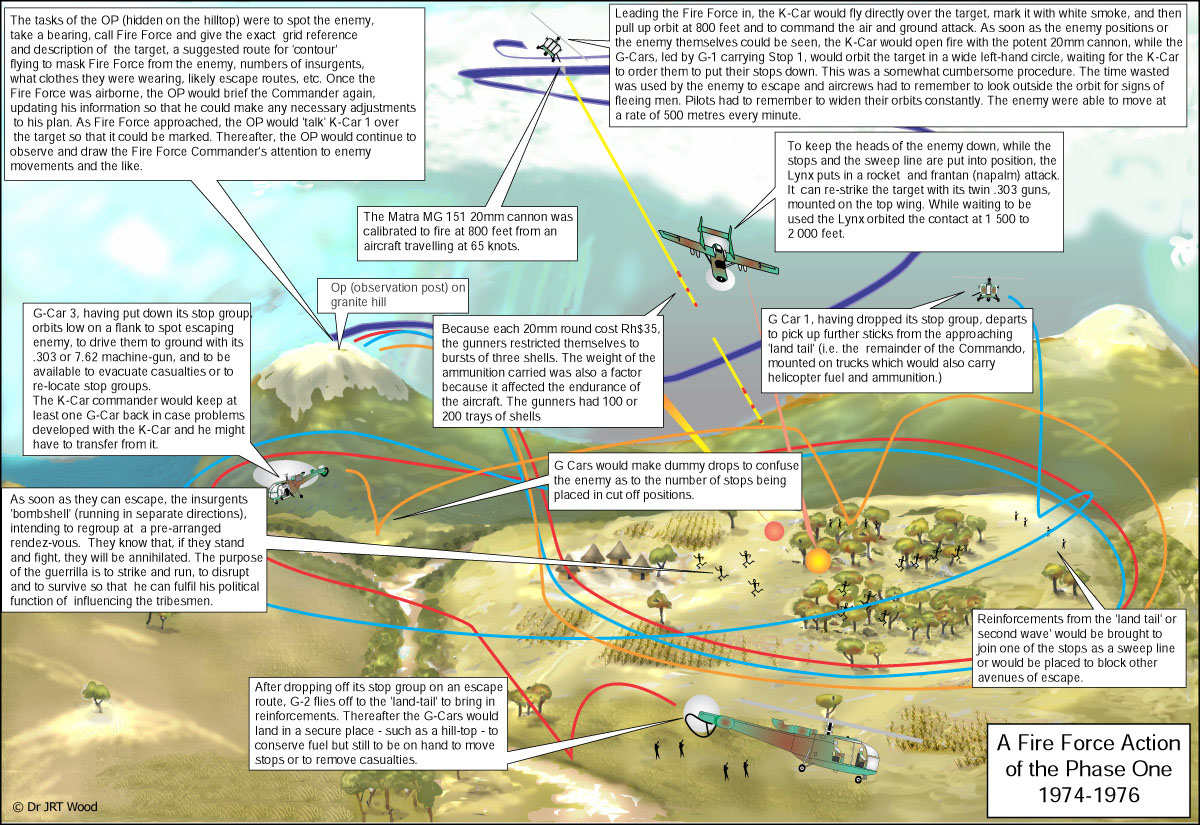
In Phase One, there would be a preliminary briefing before take-off, if Fire Force were not needed immediately. The K-Car would fly in to be talked onto the target by the personnel manning the OP (if a sighting was the reason for the call out). Difficulties of judging the position of an aircraft in the sky to a target on ground often caused delays, which afforded the enemy time to escape. When over the approximate area of the target, the K-Car gunner would throw out a smoke grenade so that the OP could use the smoke to re-direct the K-Car to the target. The K-Car would then pull up to its optimum orbiting height of 800 feet and put down fire to annihilate the enemy or dissuade them from leaving the area. The G-Cars would fly in a wider pre-arranged orbit, waiting for orders to put their stops down on the escape routes. This was a somewhat rigid, slow and cumbersome procedure and was sometimes fruitless because the enemy had fled. It was soon realised that the aircrew had to look outside the circle constantly as the insurgents covered the ground at their astonishing rate of 500 metres a minute.
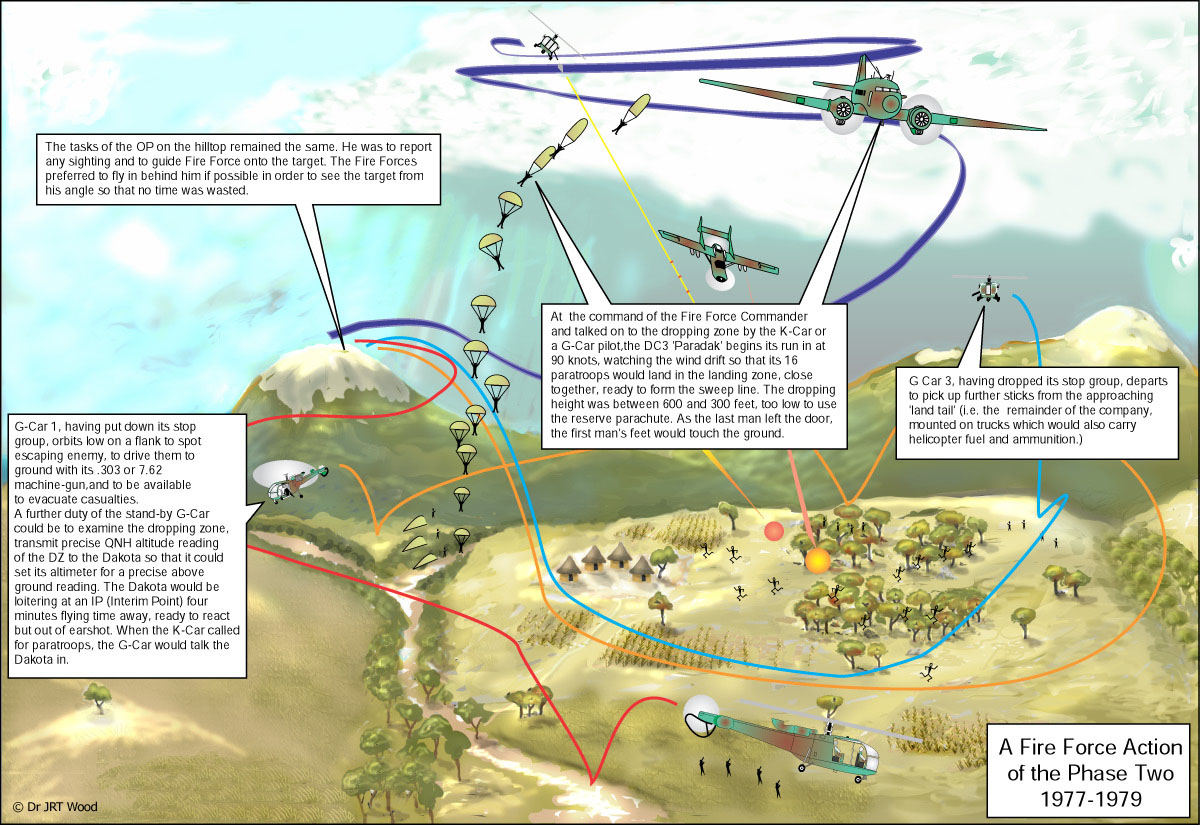
The changes made in Phase Two drastically improved the success ratio. The briefing would normally be held at the refuelling stop on the way to the target, to save time and because by then the OP would have crucial information on enemy movement or the lack thereof. By 1977 it was realised that the K-Car had to fly in from behind and over the OP in order to see what he was seeing and therefore waste no time in finding and marking the target with a white smoke generator. The K-Car would pull up and fire on the enemy. As the G-Cars arrived, they would fly directly to prescribed stop positions on the escape routes and orbit them individually. Instead of having to wait for the Fire Force commander, the G-Cars were given some autonomy. If the G-Car crew spotted the enemy, they could land their stop group without reference to the K-Car. If they did not spot the enemy, they would not put down their stop group. This meant that this stick remained airborne for quick deployment elsewhere. There would, however, be an alternative plan - Plan Alpha. The Fire Force commander would simply state 'Plan Alpha' and the G-Cars would deposit their stop groups on the predetermined stop positions. This meant minimum delay in bottling up the enemy. Once the escape routes were sealed, the Fire Force commander would have his paratroopers brought in to sweep the area, driving the quarry into the open where the 20mm could deal with them or into the ambushes of the stop groups. The achievement of Phase Two was that the quick positioning of stops often trapped the enemy.
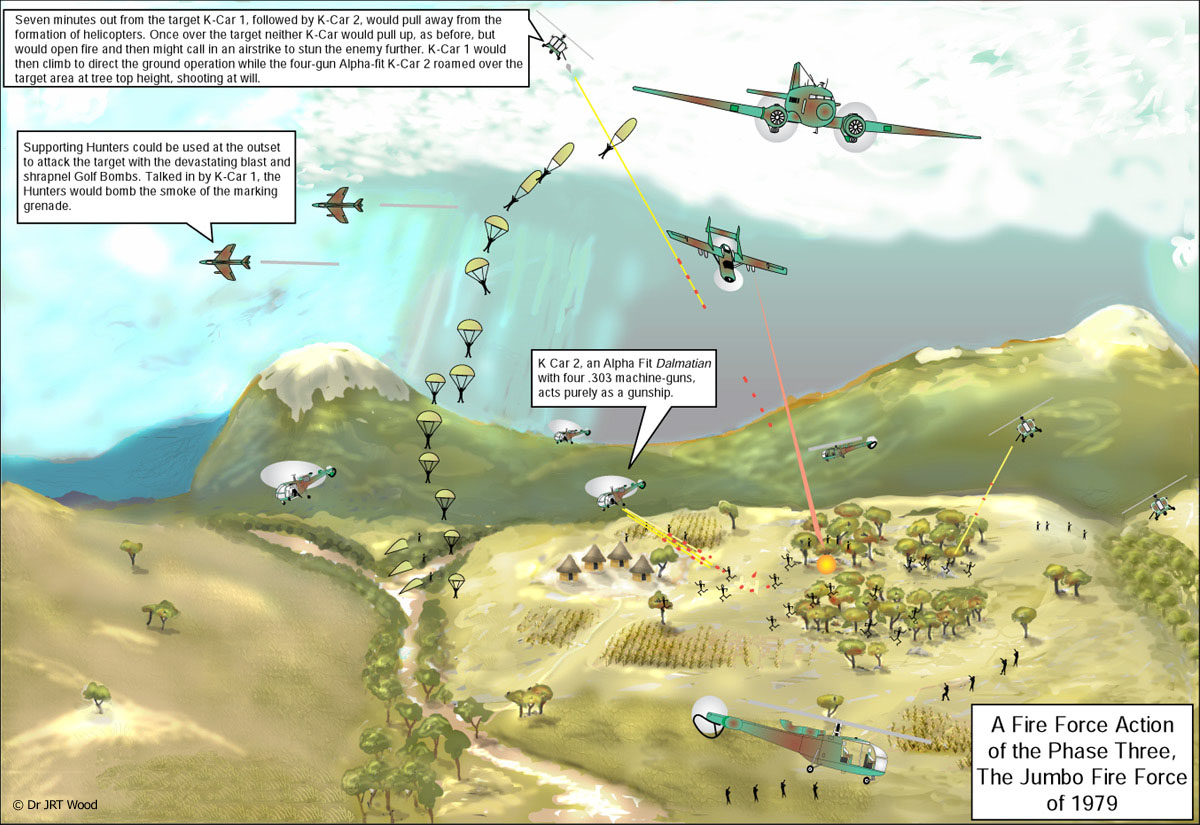
Phase Three, in which the 'Jumbo' Fire Force came into being, was the product of the constant availability of G-Cars in 1979 because the forces deployed on external operations at last had available the longer-range and greater troop carrying-capacity of the AB205A 'Cheetahs'. The Jumbo Fire Force was created by bringing two Fire Forces together, giving it two K-Cars, eight G-Cars, a Dakota and a Lynx, often with the support of Hawker Hunters. When the Fire Force was seven minutes out from the target, the two K-Cars would accelerate and pull away. Once directed onto the target, the K-Cars (being used like tanks on the battlefield) would immediately attack without pulling up, seeking to traumatise, if not kill, the enemy. The Fire Force commander might bring in the jet aircraft immediately with their devastating Golf bombs to lower the enemy's morale further. The effect would be to 'stabilise' the situation. Those insurgents who survived would go to ground. The stops would be in position quickly and the paratroops would follow to sweep the area. Actions that used to take an entire morning or a day thenceforth were often over in an hour. The commander of Support Commando, 1RLI, Major Nigel Henson recalls tackling and killing 22 insurgents at 6 a.m. By 7 a.m. his Fire Force was in action against ten more and, having dealt with them, was by mid-morning in a third contact.
In this last phase, the RLI took over the exclusive task of Fire Force, scoring formidable tallies of kills. In the period after the election of Muzorewa's Government in April 1979 until the ceasefire in December 1979,
One Commando, RLI, killed 450 insurgents
Two Commando 350
Three Commando 410
Support Commando 470
1,680
André Dennison's fine 'A' Company, 2RAR, by contrast, killed 403 insurgents in the period September 1977 to July 1979. Perhaps there is no comparison but in nine years of campaigning in Malaya, the British SAS killed 108 of their enemy.
Major Nigel Henson, who commanded Support Commando for two and a half years (1977-1979) was called out 111 times. Seventy-three of these call-outs were in 1979 and 68 of them resulted in contacts. In 1979, only one in six call-outs were unproductive 'lemons' and this he attributes to the full deployment of the Selous Scouts on the OPs and their professionalism as well as to the experienced dedication to their task of the aircrews, himself and his men. There had always been a high rate of unsuccessful call-outs but many of them were the product of the Fire Force not spending time combing the area. In many cases, if nothing appeared, despite the OP's sighting, the Fire Force would depart. Of course, it was often ordered away by the JOC to a new target.
An infantry company of the RAR or a commando of the RLI would be designated as a Fire Force at a forward airfield for six weeks, or sometimes, several months. By 1977, all regular infantry were trained paratroops and would in turn be deployed by helicopter or parachute or brought in as reinforcements from the vehicles of the 'land-tail'.
There were a number of considerations as to where the Fire Force base would be sited in an operational area. As it needed only an airstrip in the bush capable of taking a Dakota, there were a variety of geographical options for siting a base. As its role, however, was to react to incidents as they arose and, as intelligence played such a role in Fire Force operations, it was important to base the Fire Force close to the JOC and its major intelligence agencies such as the Special Branch.
The tasks of the Fire Force commander were many and varied. The pressures upon him were intense. His troops demanded kills as a measure of success. The personnel on the OPs would evaluate his performance in reacting to their sightings. The RhAF would be eyeing him critically. The burden of command was heavy and his position a lonely one. As will be seen, successful Fire Force commanders had to be men of high and varying skills.
The siting of the base was only one of the considerations for a Fire Force commander when he assumed command. If satisfied by the strategic siting, he would review the base's tactical siting, its vulnerability to attack, its defences, alarm system, the protection of the aircraft [the Rhodesians protected them with drums filled with sand, fences and overhead nets to detonate incoming rocket and mortar rounds]. He would be concerned with the communication systems, the radios that were so vital for his operations, and efficacy of the joint operations room. In the last three years of the war, the RIC was able to supply maps on which current information had been overlaid which he would need for his briefings. His troops needed to be reasonably housed, close to the aircraft for speedy call-outs. He had to establish close rapport with the senior pilot who would fly him in the K-Car and command the aircraft. He needed the active support of the FAF commander, the Special Branch representative, the technicians and base personnel. The Fire Force commander would want to know what other forces were deployed in his area, their tasks and how many would be available as reinforcements for Fire Force actions. He could never have enough men.
All related equipment had to be checked. Of crucial importance was his aircraft helmet and headset. The helmet was not just worn for protection. It muffled the engine noise, making it easier to hear transmissions. Just as vital were the links that the K-Car's intercom and radios provided with the pilot and the troops on the ground. Thus, the pressle [transmitting] switch of the microphone and the headset's connections would be tested. A spare headset would be carried in case his failed (and it sometimes did), leaving the pilot to direct the battle. The G-Cars had headsets for all stick leaders to keep them abreast of developments while in the air. The troops' VHF sets, particularly the telehand sets, had to be serviceable as more than one operation was hampered by faulty radios transmitting continuous carrier waves. The K-Car would carry two A63/A76 VHF radios, one a spare for the ground troops and the other for the commander if he had to disembark through the K-Car being forced down by ground fire or mechanical malfunction or if it had to depart for refuelling. In the K-Car with him, he would carry the radio codes and in particular the daily Shackle code. In action, some Fire Force commanders would wear gloves to cushion their thumbs from damage from the repeated use of the pressle switch. All would don flak jackets to protect them from fire from the ground when orbiting above the battle.
Along with his FN 7.62mm automatic rifle, his webbing (containing ammunition, grenades, compass, medical kit, and rations), binoculars, and a pen and notebook, the Fire Force commander would have a spare FN to issue to replace any which malfunctioned in action. The School of Infantry checklists reminded the Fire Force commander that he could not be distracted by airsickness and had to have the necessary pills on hand if he was susceptible. In practice, airsick commanders would have short careers because the K-Car pilots would not tolerate them. The checklists ordered him to have with him a talc board and chinagraphs. In practice again, he would write crucial information on the Perspex of the aircraft's windscreen. He would have complete map coverage of the operational area at 1: 250,000 and 1: 50,000 in a briefcase. The maps had to be correctly folded and indexed so that the correct one could be quickly found in the air. Numerous sets of co-ordinates were pencilled in to avoid having to unfold the whole map to find them along the edge.
The Fire Force commander would check that, as well as the small yellow smoke grenades for target marking, the helicopters were carrying large smoke generators for marking dropping zones for the paratroopers and indicating wind direction. The generators were locally produced and were designed by what Peter Petter-Bowyer describes as 'an American pyro-maniac' whom local industry had found for him. The generators produced dense white smoke, which lasted for three minutes. The G-Cars would have hoods for captives and body bags for fatalities
Each Fire Force 'stick' of four comprised: a junior NCO, equipped with a VHF A63 radio and a FN rifle; two riflemen; and a machine-gunner carrying a MAG 7.62mm machine-gun. The MAG was heavy to carry but its high rate of fire often won a fight and it was highly prized. Indeed, when they could, the stick commanders would include two MAGs in their section. If a night ambush was contemplated, and if weight was not a consideration, the stick would be issued with claymore anti-personnel mines. As they had to move rapidly over the ground, the troops dressed in camouflage tee shirts, shorts and light running shoes or hockey boots. They would carry little else other than ammunition, grenades, water, medical kits and basic rations. Short sharp action meant that they were usually back in base by nightfall for re-deployment in the morning. If they expected to set a night ambush after the contact, regulation camouflage denim uniforms would be worn and light sleeping bags carried.
Because it was crucial to the Fire Force commander to be able to see positions of his troops on the ground (to avoid sticks firing on each other and the like), methods of visual identification would be adopted. Troops would use strobe lights (if available), heliographs, orange 'dayglo' or white panels, smoke and white phosphorous grenades, or flares. Often the troops would simply wave the white backs of their maps. One Support Commando stick leader, 'Messus' Moore, was asked to reveal his position by displaying his map. He replied that, as he had forgotten his map, he would hold up his cigarette packet. His Fire Force commander, Major Henson, surprised to see the upheld packet, responded 'Stop One, are they Kingsgate or Madison?' [two Rhodesian blends].
Most vital was the teamwork in the K-Car. The Fire Force commander would take every opportunity to discuss methods, ideas, latest tactics and lessons learnt with his K-Car pilot. They would find time to practise their roles in the air. As the pilot had the aircraft to fly, and the air gunner/technician sat well back behind the 20mm cannon, it was the Fire Force commander who could concentrate solely on spotting the enemy. Sitting on the left in the front, he was well positioned to do so. Thus, he could play a crucial role in target identification, for example. This had to be rapid and precise. On spotting the enemy, he would call a course correction - 'Hard left!' - and point out a feature close to target and order the firing of two rounds. He would then correct the gunner's aim from the strike of the shells. Fire Force commanders and pilots, of course, had much on their minds and very often keen-eyed, experienced gunners saw the enemy first. Following the action intensely, the gunners would prompt the Fire Force commander on orientation, the whereabouts of stop groups and other details. The Fire Force commander had also to understand what the aircraft could and could not do, particularly how long it could fly. Such matters were, of course, the responsibility of the pilots, but experience taught the Fire Force commanders to keep an independent eye on the fuel gauge, as they had to base their plans on the aircraft's performance.
There was much initial planning to be done and the Fire Force commander, his second in command, his officers, the senior and other pilots, the FAF commander and the operations and intelligence officers would meet to review the current intelligence, discuss activating call-outs, and general modus operandi.
The RhAF personnel would detail how many aircraft were available. The use of the Dakota would be reviewed including the height and number of paradrops, the drop procedure, the radio channel for drops, emergency drills and the use of 'wanker' sticks (men dropped purely to collect the parachutes as sanctions made their replacement costly and difficult). The 'wanker' sticks more than once found themselves in action when fleeing insurgents broke through sweep lines. The Lynx and its weapons would be discussed. Command, briefing and spare radio channels would be allocated. The Fire Force commander would select an alternative VHF channel for the ground troops so that the command net did not become cluttered. This channel could be monitored by the accompanying Lynx on its second radio. Aircraft formations to be used en route to targets, the masking of aircraft noise and associated problems would be examined. Colour codes would be selected: for example, G-Car One might become Yellow One. The provision for refuelling and rearming would be laid down. Finally, the equipment to be carried by the aircraft would be reviewed - the smoke generator, spare VHF radios, spare rifles, body bags etc.
The Fire Force commander would describe the stop details; the callsigns; their equipment; and the dispersal of medics and trackers among the sticks. He would deal with the 'land-tail', selecting its commander, escorts, medics, trackers and the 'second wave' reinforcements. There was a tendency for everyone at a Fire Force base to volunteer for the 'land-tail' but essential functions at the base could not be neglected, men had to be fed on their return and much more.
There would be a general briefing of all personnel on call-outs, briefings and methods. The latter would include: the OP talk-on; target marking (using the Lynx or the K-Car to deliver smoke or the firing by the OP of Icarus, Very, the SNEB rocket [the shoulder-held launcher which Petter-Bowyer had developed] or Miniflare markers); target correction; the marking the position of the troops (by orange dayglo or white panels or by waving the white back of maps or the use of smoke grenades, flares, instant light, heliograph); smoke signals (blue for casevac, orange for radio failure, white phosphorous for a contact and the white generator for a dropping zone). Details of the casevac procedures would be given along with the proximity of hospitals or mobile resuscitation units. The use of air support, tactics in general and post-contact procedures would be discussed.
The meeting would review the recovery of the heli-borne troops, the paratroops and their parachutes, the second wave sticks and the dead and captured insurgents and their kit. The information required from an OP for a call-out would be laid down - the map number; the OP's locstat, callsign, radio channel; the locstat of the enemy, their numbers, weapons, dress and current activity. The Fire Force would want to know: if the OP could still see the enemy or where they were last seen, their escape routes; the nature of the terrain; possible landing and drop zones; the compass bearing from the OP to the target; the proposed method for the OP marking the target; and the locstats of other OPs or nearby troops.
If time allowed, all Fire Force and base personnel including the RhAF would practise the immediate action on call-out, familiarising themselves with emplaning, deplaning and other drills. The troops would practise fire and movement, movement across open ground, cave and obstacle clearing and other tactics. They would zero their weapons on the range and practise quick reaction snap shooting on jungle ranges [bush ranges with targets that sprung up].
Out in the field, hidden in the hills, would be the OPs of the Selous Scouts, other Rhodesian Army or Police units. Once a target was spotted, the OP commander would report to his unit, supplying his locstat, callsign etc. He would stand by, observing the enemy while Fire Force was activated. Everything would be done with a minimum of words for efficiency. The OP commander would be ready to update his report for the incoming Fire Force.
At the call-out, sometimes initiated by the sounding of a klaxon, the troops of the Fire Force would follow the rehearsed procedures. In the early stages, the reaction times were as little as four minutes. It was soon learnt that time taken in briefing was more valuable than speed and the Fire Force would take 10 minutes to get airborne. It still depended on the nature of the reported incident. The first question asked was always: 'How much time have we?' Often, there was no choice but to get the aircraft airborne and to plan on the way to the target. In addition, a refuelling stop on the way would provide time for a methodical briefing.
The Fire Force commander and the K-Car pilot would make a quick appreciation of the OP's report and devise a plan to preserve the element of surprise and annihilate the enemy. The K-Car pilot would examine the route and consider various options such an initial air strike by the Lynx (some Fire Forces preceded attacks with a mini-Golf bomb) or, if the target warranted it, by Canberras or Hunters, to stun the enemy and drive them to ground. He could use of noise cover by preceding the helicopters with a Trojan or Lynx. The entire Fire Force could arrive simultaneously from different directions or the K-Car would accelerate to arrive over the target first to allow the Fire Force commander to orientate himself, confirm the OP's information and to reassess his appreciation before his troops arrived. The Fire Force commander and the K-Car pilot would select the optimum killing zones into which the enemy could be driven. They would identify escape routes, such as thickly bushed riverbeds and ravines, which should be blocked by stop groups. To contain the insurgents they would plan dummy drops of stop groups by the G-Cars and the positioning of their assault troops near enough to the target to be able to exploit the shock of the initial airstrike by the K-Car or fixed-wing aircraft. They would select a rendezvous for the aircraft to meet the vehicles of the 'land-tail'. This would be as close as possible to the target area and would be in a sufficiently open area to allow two or more helicopters to land, refuel and re-arm simultaneously. However, to avoid casualties and the loss of vehicles, the 'land-tail' would often only approach on tar roads to preclude the danger of mines. The Fire Force commander and the K-Car pilot would select dropping zones for the paratroopers with a view to bringing them quickly into the action. They would plot the position of other security forces in the area to avoid firing on them and to employ them, perhaps, on the periphery of the battle to intercept any fugitives. They would review their firepower requirements. Teargas to drive insurgents out of difficult places, such as caves, could be carried. Finally, they would consider having a deputy Fire Forces commander carried in the Lynx to co-ordinate the resupply by the 'land-tail', using the aircraft's second radio, and pass any developments to the JOC. The Lynx pilot, himself, might be used for these tasks.
The plan would be presented at the overall briefing. While the K-Car pilot briefed the aircrews and operational staff on the aircraft involved, airstrikes, routing plans and refuelling, the attack directions, the drop plans, refuelling and recovery arrangements, the Fire Force commander would be describing to his stick commanders and the second wave the known details of the target [the map reference, estimated numbers, enemy dress, weapons, current activity, etc.] and the plan. He would allocate the radio channels and appoint the heliborne stop groups [giving them easily remembered callsigns such as Stop One, Stop Two etc and placing Stop One in G-Car Yellow One, Stop Two in Yellow Two and so forth]. He would describe their drop plan [arranging it in a counter-clockwise sequence in the order of their stop numbers so that he could remember where they were and everyone could recall easily who was on their flank]. He would point out the dropping zone for the paratroopers and give details of the deployment of the second wave and the equipment and ammunition to be carried by the 'land-tail'. If he assigned a stick the task of searching for the enemy, the Fire Force commander had to ensure that it contained trackers or he would reinforce it with trackers.
The Fire Force commander would remind the stick commanders of pro-words to be used such as 'Stop; Show Map' [the white back of a map would be waved to indicate a stop's position]; 'Show Dayglo' [the troops had 'dayglo' orange panels and sometimes 'dayglo' linings to their combat caps which, when the cap was turned inside out, would indicate to the aircraft that they were friendly forces]; 'Throw Smoke; Go Two for uplift'. A most important statement was 'Ters visual' because too often a stop group would catch sight of the enemy but, when trying to report the sighting in a normal manner, would be told 'Wait, out' by a busy Fire Force commander.
The stick leader would return to brief and inspect his men, checking the number and condition of their loaded magazines, machine-gun belts, grenades, field dressings, rations, water bottles, sleeping kit. He would share out: the spare radio batteries, the pangas and toggle ropes [for use in difficult country]. He would check the medic pack and detail who would carry it. He would show his stick where he carried his morphine. He and his men had to use camouflage cream to darken their fair skins a white man's skin, even darkened by sunburn, could be seen at a considerable distance]. He had to ensure that all controlled stores [compasses, binoculars etc] and his codes were secure and waterproof. He had to remember that he had a clean white backing to his map, that he had written his radio callsign - Stop One, for example - on his hand. He would detail positions in the G-Car and remind his men of the emplaning and deplaning drills. The MAG gunner would take the rear right seat to give the aircraft additional firepower if the pilot requested it, (for example, to keep enemy heads down when landing). The riflemen would not fire from the aircraft because, unlike the MAG, the FN ejected the spent cartridge case upwards into the spinning blades. The riflemen could also easily hit the blades from a tilting helicopter. An additional reason was that loose cartridge cases rolling around on the floor could be sucked out of the open doors and rearwards into the tail-rotor. The G-Cars guns for this reason ejected into shoots. The riflemen would take the middle rear and front seats, leaving the stick commander the left front seat and the spare headset so that he could follow the progress of the deployment and receive his orders.
The paratroop stick leader would detail the order of the stick. He would remind the stick to watch where the rest of the sticks landed. He would brief stick on regrouping channels and which was the senior stick. All stick leaders would remind their men of tactics, formations: the drills for clearing kraals and caves, for crossing open ground, the use of fire and movement; what to do if the radio failed; arcs of responsibility, hand signals; action on contact with the enemy, the use of smoke, of grenades, target indication. Men would be assigned the searching of bodies and warned against looting. Chains of command within the stick would be established and everyone would be apprised callsigns and radio channels.
The stick commander had to answer his radio first time, (in Support Commando failure to answer immediately would draw the response of a cannon shell from the K-Car which would have an electrifying effect - it would also confirm that a radio was not working). He had to remember that he was responsible for the success of his men. If he had 'wankers' or useless members in his stick, he was to report to his Troop or Platoon commander. He was warned: 'If you don't brief your stick properly you will have your arse kicked.'
Once the Fire Force was airborne, the responsibilities of the K-Car Pilot were navigation, communication with OP including the OP's talk-on to the target and the co-ordination of the arrival of the fixed-wing aircraft. The Fire Force commander and the K-Car pilot would consult the OP for an update on the target, review the plan and brief the stick commanders and the G-Car pilots over the radio on any changes. If the call-out had been rapid, this might be the first briefing or the first briefing might be held at the refuelling stop en route. The Fire Force commander would order the second wave sticks to move to their rendezvous point to be ready for uplift by the G-Cars. He would remind the sticks how they would be able to recognise the K-Car, by its rotating beacon or by letters or numbers on its belly or by the height, 800 feet, at which it flew. The G-Cars, by contrast, would be hugging the treetops for safety.
The Fire Force commander would establish communications with other ground forces to confirm what callsigns were on the ground, their position in relation to the target, and who was the senior callsign. When reviewing his selected dropping zone, the Fire Force commander had to remember that paratroops were not limited by a few trees on the dropping zone, but heavily wooded areas could be dangerous as were rocks, sloping ground, powerlines and 15 to 20 knot winds. He had to remember that he and all his troops had to be orientated on the approach. Paratroops, in particular, had difficulty in seeing the target area.
On arrival, the OP would give the Fire Force commander the latest information and talk the K-Car onto the target, indicating it with a tracer bullet or other means. Ron Flint, a somewhat flustered territorial sergeant, of the Fifth Battalion, the Rhodesia Regiment, pointed his pencil flare projector and informed the incoming K-Car just behind him: 'Marking Target NOW!' The pencil flare refused to ignite. Coolly observing Flint's agitated efforts, the K-Car pilot laconically commented from above: 'Don't worry. I can see where your finger is pointing.' On another occasion, great difficulty was experienced in spotting the smoke of the target marker (an adapted SNEB aircraft rocket), because the Selous Scout OP, a black sergeant, had marked the target so well that the rocket was buried in the chest of one of the enemy, dampening the smoke. The Selous Scouts did not, however, always mark targets because they would be acting as pseudo gangs and wanted to appear to the tribesmen as the survivors of any contact.
The Fire Force commander would select the most prominent feature to the north of the target as a main reference point and orientate himself with the terrain - the hills, rivers, roads, maize fields and habitation and the direction in which the terrain and rivers ran - because his own disorientation was a real possibility as the K-Car orbited.
Pulling up to 800 feet the K-Car pilot would control all aircraft movements and the use of their weapons. As overall commander, the Fire Force commander bore the responsibility for the success of the engagement and would make his final tactical appreciation, bearing in mind the speed of the enemy's flight and the objective of preventing their breakout. He would intend to 'stabilize' them to ensure their elimination or capture. The insurgents could be expected to 'bombshell', fleeing in all directions to make it difficult to track them. Thus, dummy drops would be used to convince them that there was no way out of the trap. The orbiting aircraft would deter them from moving across open ground and a pre-planned airstrike or a burst of K-Car fire could stun them into immobility. The Fire Force commander, however, would not deposit his men on the ground until he had a clear idea of the incident - sighting, ambush or reported insurgent base.
The Fire Force commander would quickly confirm where the stops should be placed and the K-Car pilot would direct the G-Cars to their landing zones. The commander was trained to draw a sketch-map of the contact area and to mark on it the positions of stop groups. When a stop group moved, he would re-mark its position on the sketch-map to avoid contacts between friendly forces. Control from the air by the Fire Force commander was crucial so it was essential, as has been said, that he remain over the target area at all times, changing to another aircraft if necessary. He also had to be ready to react speedily to changing situations. If the insurgents broke out of the net, the Fire Force commander had to deploy his trackers early to establish the direction of the enemy's flight so that he could leapfrog his stops ahead to cut them off.
Once his men were on the ground, the Fire Force commander had to recognise their problems and assist them with them. If a stick's radio failed, and if he could not land to replace it with the spare, he would ensure that the stick did not move and therefore not blunder into a killing ground. As soon as he could, he would unite them with a stick, which had communications. The commander was not to set his sticks impossible tasks nor was he to expect them to take independent action. He had to ensure that they identified the features of the target and were properly orientated, knowing who was on their flanks. He had to appreciate their difficulties in crossing terrain and not over-estimate the speed at which they could move. It was not advisable merely to give men the grid reference of their objective if it was possible to describe the route or if the K-Car could indicate their objective by overflying it. Anything that could assist the sweep and stop troops would enhance their performance.
It was vital to apprise the sticks of what was happening, what the enemy was doing. This did not mean that the Fire Force commander had to provide a running commentary because the stick leaders would be monitoring to the radio transmissions. The Fire Force commander was, of course, in a superb position, orbiting at 600-800 feet and sitting on the extreme left of the aircraft to guide his men.
In quiet moments the Fire Force commander would have the K-Car orbit the sticks to confirm their positions and to reassure them. The sight of the supporting fixed-wing aircraft striking the target was always good for morale as was the rapid evacuation of any casualties by the stand-by G-Car. Prompt congratulations from the K-Car for any success also boosted morale and preserved the vital intimate trust between the commander in the air and the men on the ground.
There were fundamental rules with regard to tactics, which could not be broken. The first was: never to sweep uphill - always downhill; the second: never to sweep into the sun; and the third was always to sweep from cover into open ground - never from open ground into cover. Major Henson recalls that, whenever he broke these rules, he lost men - five in all. In addition, he would only break the rules because time was pressing, the sun was setting and there was no time to get his men round to the top of a hill to start a downward sweep.
It was imperative that the Fire Force commander appeared and sounded calm and confident. Any displays of impatience, excitement or anger would only rattle inexperienced sticks and prompt a mutinous reaction from experienced ones slogging through thick bush in the heat. Calm tones, clear, crisp explanations had a sobering effect on jittery ground forces. This was particularly important when dealing with African forces whose command of English was often not good and who might not understand brisk, terse commands, mistaking 'affirmative' for 'negative', for example. The Fire Force commander would allow time for aircraft noise to diminish before speaking to a stick and would arrange that aircraft orbits were sufficiently high and distant to avoid deafening the stick leaders. An important duty was to control radio transmissions to prevent the channels becoming cluttered with unnecessary 'waffle'.
The Dakota bearing the paratroops would have flown to an 'IP' (intermediate point) four minutes away, out of earshot, to await developments. The Fire Force commander would use his stops and his firepower to stabilize the situation by immobilising the insurgents. Once he had stopped their flight and driven them to ground, he would bring in his paratroops to sweep the area, driving the enemy into the open (the favoured killing ground of the aircraft) or into the waiting stop groups. Before having his paratroops dropped, the Fire Force commander would ask his K-Car pilot or the first available G-Car to confirm that the landing zone was suitable, bearing in mind the vulnerabilities of the paratroopers - exposure to enemy fire in the air, cross-winds and rough landing zones. The G-Car might establish, by landing, the precise altitude of the LZ and transmit the QNH setting for the Dakota's altimeter. The K-Car or G-Car would mark the centre of the dropping zone with smoke and talk the Dakota in.
Where possible, the troops would be dropped facing the contact area, in the direction of their sweep. It took considerable skill by the pilots to position the Dakota precisely, when flying at 90 knots (to create sufficient slipstream to open the canopies), so that the paratroopers landed on the often small dropping zones. For mutual defence and for efficiency it was essential that the paratroops came down close to each other. To expose the paratroops to ground fire for the shortest time, the prescription for the drop was from 500 feet and never lower than 450 feet. The D-10 American parachute used required 250 feet in which to open fully and in fact, drops were often made from 300 feet so that none of the paratroops drifted off the dropping zone. The Fire Force paratrooper carried little more than his weapon, ammunition, grenades, and water and thus was not heavily burdened, as often is the case in military jumps.
The advice was 'Rather too high than too low'. On 17 February 1978, however, paratroops from A Company, Second Battalion, the Rhodesian African Rifles, were dropped at 300 feet due to an error of 150 feet in the setting of their Dakota's altimeters. Their commander, Major André Dennison, estimated that the canopies were open for only nine seconds before the men struck the ground - unharmed. John Hopkins, late of the RAR, maintains that in fact RAR probably held the record as 16 paratroopers commanded by Lieutenant 'Blackie' Swart jumped on 9 October 1978 at something less than 300 feet, through a pilot error. They hit the ground only as their chutes began to deploy. None were killed in the fall but eight were injured, four of them seriously. Four days later, an MAG gunner died from a fatty embolism being released into his bloodstream. The RLI, however, would dispute Hopkins's claim as in 1979 a Support Commando drop near Rushinga left 14 of 22 men injured when their Dakota maintained a constant height over rising ground. The first men went out at 250 feet but the last jumped at 200 feet.
Once on the ground the paratroops would marry up using a separate radio channel and once gathered together, report 'ready' to the Fire Force commander. They would lay out an identification panel and face the contact area. The Fire Force commander would attempt to observe the landing so that further indications were not necessary. Only the leader of the senior stick of each group would report in once he had regained control of all sticks under his command. The parachutes would be abandoned to be picked up later by the closest troops after the contact. Alternatively, a 'wanker' stick would be dropped to collect the parachutes.
The Fire Force commander also had to brief all fresh troops on their way to the contact. While doing all this, he would keep the JOC informed so that it could plan its wider reaction. He would bring in his reinforcements as soon as possible as he could never have enough troops on the ground and might need a reserve on hand for decisive action or for unforeseen eventualities. When the reinforcements arrived the K-Car would lead their helicopters through the pattern of landing zones, ordering each G-Car to deploy its troops when the particular landing zone was flown over, to maintain the order of the deployment.
The enemy had to be dealt with immediately and never left alive and unattended. Sweep lines were to disarm and to frisk all insurgents alive or dead on the first sweep. This was to be done because insurgents were known to feign death when fired on by the K-Car and then abscond when the sweep line had passed through. It was essential that the first captured insurgent was flown out immediately for proper and prompt interrogation because he could reveal precisely how many enemy were in the area, what their intentions were, where they intended to rendezvous, their destination, last base and name of their leader. The Fire Force commander would take care not to compromise the identity of captives, masking them with hoods, keeping them away from the locals because in many cases they would be 'turned' and recruited into the Selous Scouts for pseudo operations. Thus, their local identity as ZANLA or ZIPRA insurgents had to be protected.
The Fire Force commander would make maximum use of fire from the aircraft into known insurgent positions. He would use the G-Cars for flushing fire so that the K-Car remained on station above the target. Flushing fire or 'Drake' shooting was also used by the sweep lines. The troops would fire several rifle shots into bushy thickets to drive out the insurgents from hiding places. To promote accuracy and conserve ammunition, the Fire Force troops fired their FN Rifles on semi-automatic rather than full-automatic. Fully automatic fire was restricted to the MAG machine-gun, which would be used to lay down sustained fire, to cover the outflanking of the position by the remainder of the stick. When insurgents were trapped, the sticks would often call for fire from the K-Car or other aircraft after the enemy position had been marked by the ground forces with a smoke grenade and the stick had been pulled back.
Most contacts were with small groups so the Fire Forces usually outnumbered their opponents. Later in the war the Fire Forces did confront groups of a hundred or more but were never defeated, never driven away. Much of the reason was the presence of air power, particularly the K-Cars and their 20mm guns but part of it was the discipline and training of the Fire Force troops and their marksmanship. Their opponents, by contrast, fired widely and on automatic. Long bursts from an AK lift the barrel towards the sky.
Once the contact was over, the Fire Force commander would have the target area thoroughly searched so that all abandoned equipment, ammunition and spent cartridge cases were picked up. This was done for ballistic, intelligence and other purposes and to deny the survivors' ammunition. If there were time, the Fire Force commander would document bodies, weapons and equipment. Even if no enemy were encountered, careful sweeping was required so nothing of intelligence value was missed. The next step was the recovery of all the dead and captured insurgents and their arms and equipment by helicopter or vehicle. Parachutes and the troops on the ground would likewise be recovered. In many cases, the troops would be ferried to the Dakota waiting on a nearby strip or to the vehicles of the 'land-tail'. If necessary, troops would be left to ambush the contact area or to follow up on the tracks of the fleeing survivors. The Fire Force commander, before leaving the area, would brief them on their task, directing them to ambush positions and assigning radio channels for communication with him and the Fire Force base. He would ensure they were adequately equipped for their task and, in particular, that they had the correct maps. If they were needed for fresh sightings the next morning, they could be recovered by helicopter with relative ease. It was not necessary for them to return to their base every time.
Once everyone was back at base, the Fire Force commander would debrief those involved. He would review the course of events: the initial briefing; the accuracy of the original intelligence; the choice of routes to the target and the formations flown; the calibre of the talk-on and the identification by the OP and the OP's subsequent action; the noise factor; the possible compromise of the OP; actions by local inhabitants; the difficulties presented by the insurgents' choice of base; the efficacy of air weapons; the performance of the troops on the ground - the stops, the para-drop, the sweeps and action on contact; casualties and their subsequent extrication; reasons for insurgents escaping and their numbers; and the efficiency of the recovery and any subsequent action. The Fire Force commander would transmit his comments to the unit, which had supplied the OP.
Rhodesian national servicemen in the independent companies of the Rhodesia Regiment at times served as Fire Forces, as did the First and Second Battalions of that regiment, and many impromptu Fire Forces were created by troops present at a JOC. The permanent Fire Forces, however, were drawn from the ranks of the white regular soldiers of the Rhodesian Light Infantry, who achieved the highest kill-rate with relatively small loss to themselves, and the black professional soldiers of the Rhodesian African Rifles who also achieved enviable results. The troops assigned to the Fire Forces could expect to find themselves called out two or three times a day. Many call-outs produced 'lemons' because the intelligence was faulty or the insurgents had disappeared into the bush or had melded into the local population or because the Fire Force did not spend enough time searching the area of a sighting. With deployments in the Rhodesian bush war as long as six-ten weeks, the strain would often tell. Three operational jumps in a single day was something no other paratrooper had ever been expected to do. Indeed other paratroops of other nations had endured nothing like it. In 1950-1952, for example, the French Colonial Paras in Indo-China proudly boasted of their fifty odd combat jumps. This was more than double the 24 operational jumps, which the two vaunted French Foreign Legion Para battalions made between March 1949 and March 1954. Altogether, the French were to make over a hundred combat jumps while later in Vietnam the Americans only made one major combat jump. The Americans, of course, were by then making tactical use of helicopters.
The records of Support Commando, 1RLI (commanded by Major Nigel Henson) in the crucial months of February to May 1979 give a taste of Fire Force action at the height of the war, at the moment when the new constitution of Zimbabwe-Rhodesia was brought in, conceding for the first time majority rule.
In late April, Bishop Muzorewa and his United African National Council gained the majority of the seats in the new Legislative Council with the overwhelming support of the electorate who had defied the efforts by the ZANLA, and the Zimbabwe People's Revolutionary Army (ZIPRA) (the military wing of Nkomo's ZAPU), to deter them from voting. Muzorewa's popularity would quickly fade because the governments of the west, and, in particular, the new British Conservative Government of Margaret Thatcher, refused to recognise the legality of his election.
The forces ranged against Muzorewa - ZANLA and ZIPRA - took a terrible pounding from the onslaught of the Rhodesian security forces both internally in Rhodesia and externally in their host countries of Mozambique, Zambia and, on one occasion, deep in central Angola. Support Commando was in the thick of the fighting as one of five Fire Forces. The pilots of the Fire Forces had the additional burden of constantly being drawn away to support a programme of continual air and ground external attacks by the Rhodesian SAS and Selous Scouts. In April, Support Commando itself would raid Mozambique.
In February 1979, Support Commando was supplying troops for two Fire Forces, Delta and Echo. On 22 February, at 1.45 p.m. on a bright, very hot afternoon, elements of Support Command, 1RLI, acting as Fire Force Delta and commanded by Lieutenant V.A. Prinsloo, contacted twelve green-clad ZANLA cadres at UL 128518 [a grid reference ] in the mopani forest and thorn bush of Sengwe TTL in the extreme south of Rhodesia, close to the South African and Mozambican borders. Fire Force Delta had been brought in to reinforce a callsign of the mounted infantry regiment, the Grey Scouts, who had been on the spoor of a group of ZANLA. The Greys had killed an insurgent and called for Fire Force Delta to seal off the escape routes with stop groups and sweep the area.
Fire Force Delta (comprising a K-Car, three G-Cars and a Lynx) had been pre-positioned nearby but in the five minutes it took to reach the target, the ZANLA were fleeing south-east. The Fire Force flew over the southern area and a keen-eyed trooper in a G-Car spotted the insurgents some three kilometres from the contact area. The K-Car attacked the group while Stop One was dropped on a riverline a kilometre west of the target. Stop Two was dropped about a kilometre south of Stop One on a track. Both stops swept eastward parallel to each other. Stop Three was dropped in a small kraal 800 metres to the west of the target. By this time, the insurgents had bombshelled, fleeing in all directions. One insurgent put up his hands and surrendered to the K-Car. He and a wounded man were taken into custody by Stop Three who immediately thereafter killed a third. The K-Car's 20mm cannon knocked down three insurgents in a gully a hundred metres away to the west and sent Stop Two to investigate. The K-Car scored its fourth kill another hundred metres on and dispatched Stop One to clear the area. The Lynx pilot then spotted two ZANLA running west behind Stop One who turned about and searched west along the other side of the riverline. The Lynx put in two Frantan attacks onto these two insurgents, apparently without success, but Stop One killed an insurgent on arrival, re-swept the area and shot and killed two more.
Lieutenant Prinsloo recorded in his report that nine ZANLA were killed, two were captured and one escaped. He noted the poor state of the ZANLA weaponry, with its woodwork old and rotting. Four SKS self-loading rifles, six AK and one AKM assault rifles, six stick grenades, twelve thirty-round AK magazines, one forty-round AK magazine, three percussion grenades, 2,000 rounds of 7.62 intermediate rounds, five RPG7 rockets and four RPG7 boosters and an 82mm mortar secondary were recovered. The twelve RLI troops had fired 250 rounds of 7.62mm ball and had thrown a white phosphorous grenade. The K-Car had fired a hundred rounds of 20mm and the Lynx had expended two Frantan bombs and fired 120 rounds of .303-inch ball from its front guns. A mini flare projector had been lost as well as three FN magazines. Prinsloo noted that interrogation had revealed that the insurgents had not known that the Fire Force was in the area despite its earlier move to a position close by to await the call-out.
Two days later, at 10.30 a.m. on the rainy morning of 24 February, Support Commando's other Fire Force, Echo, commanded by Major N.D. Henson, contacted an unknown number of ZANLA at US 222435 in the Chiweshe Tribal Trust Land, north of Salisbury and south-west of the white farming area of Centenary. Henson was faced with many problems. He had only a K-Car, a G-Car and a Lynx; the target area was large (five kilometres by three) and covered in thick bush. Visibility from the air was poor and heavy rain swept in at ten-minute intervals throughout the day. Henson had responded to a confirmation received at 10.15 a.m. from the Special Branch that ninety-five insurgents were in the area but he was not given a precise location. Henson had been forewarned and, having only one troop-carrying helicopter, had pre-positioned his second wave sticks, comprising six RLI and ten Police Anti-Terrorist Unit sticks [64 men in all] with fuel about five minutes from the contact area.
No movement was seen from the aircraft when they arrived over the suspected area. Henson deployed Stops One-Seven in a curving line from south to north along the banks of the Ruya River. Stops Three-Five started sweeping northwards and contacted an insurgent across a small tributary of the Ruya. The result was the wounding of Trooper Cummings so Henson requested airstrikes by the Lynx with Frantan and a mini-Golf bomb. He reinforced Stops Three-Five with Stops Six and Seven but ZANLA replied with mortar fire. Henson moved Stops Eight-Eleven to the west and had them sweep north-eastwards. Stops Three-Seven killed an insurgent armed with a 60mm mortar on the hill in front of them and then resumed their sweep. On the second central hill, Stop Eight reported ZANLA ahead. The Lynx and the K-Car attacked but an immediate sweep found nothing. Henson ordered a further sweep of the area, and this time Stops Three-Seven came under intense fire from the summit. Further airstrikes were put in and the sweep line found three ZANLA bodies on the northern flank of the hill.
In his report, having recorded the killing of four ZANLA, the escape of fifteen, and the wounding of Trooper Cummings, Henson stressed the difficulties of operating in heavy rain, which had masked the escapes. The size of the area of operations had also militated against a bigger kill. An AKM assault rifle, a PPSH submachine-gun, a 60mm mortar, grenades, ammunition and documents were recovered and handed to the Special Branch at Mount Darwin. Henson confessed that the idea of tackling 95 ZANLA with a K-Car and a G-Car was daunting because the lack of G-Cars had drastically limited his ability to move his troops. Those killed, Henson wrote, had been more inept with their attempted escape than he had yet experienced.
At 6.30 a.m. in the difficult light of the early morning of 6 March, Lieutenant V.A. Prinsloo's Support Commando men of Fire Force Delta contacted seven ZANLA, at TL 016872 in grassland with scattered trees and thorny undergrowth in the Mtetengwe Tribal Trust Land, north of Beit Bridge in the south of Rhodesia. Intelligence gathered by One Independent Company, Rhodesia Regiment, (1 Indep) had led the JOC to devise an all-arms programme to attack five ZANLA camps. The first and second camps (at SL 978892 and SL 971887) were to be bombed by a Canberra at first light. Simultaneously, with a K-Car, three G-Cars, a Lynx and a Police Reserve Air Wing aircraft (PRAW), Fire Force Delta was to attack the third (at TL 016872) while the fourth and fifth (at SL 955853 and SL 956841) were to be engaged by artillery.
The plan went somewhat awry. The artillery bogged down on the mud road and could not get into position. The Canberra had communications problems and had to abort.
Undaunted Fire Force Delta, which had been pre-positioned nearby, decided to continue with its task. Stops One and Two were dropped on a 'cut line' [a bush-cleared fire break] to the east of the third camp. Stop Three was placed on a ridge in the south on the river, which ran directly north to the camp and beyond. When the K-Car flew over the camp, Prinsloo could see the sleeping places and the blankets but no movement. Stops One and Two moved directly west along the cut line to the river and then along its banks southwards towards the camp. On reaching the proximity of the camp area, they shot and killed three ZANLA in the undergrowth. The thorns were so thick that the troops spent much of their time on their hands and knees. An insurgent killed himself by blowing his head off with a grenade. Seeing movement in the undergrowth, the troops fired and killed ten African women. Prinsloo had Stops Four and Five dropped in the east on a tributary of the main river to work down it towards the camp. Stops One, Two, Four and Five then swept the swamp just to the north, working up the main river towards Stop Three. In the thick thorn bush, six more African women were killed in dense thorn bush. The sweep returned towards the camp and captured two females. The bodies of a female and an insurgent were recovered. The thorns were so thick that the bodies of the other three insurgents and the African women could not be recovered and were left behind. The captured females informed the security forces that the camp had held seven insurgents and eleven women. In the aftermath, the troops were sent on foot to check the other four camps, finding them unoccupied.
Lieutenant Prinsloo recorded the score of four ZANLA and eight civilians killed, and that his 20 men (12 RLI and 8 riflemen from 1 Indep) had fired 500 rounds, expended four white phosphorous grenades and a high explosive grenade. The K-Car had fired fifteen rounds of 20mm. The troops had lost a MAG belt. An AK, a SKS, two stick grenades, an offensive grenade, seven AK magazines and 500 rounds of 7.62mm ammunition were picked up.
At 11 a.m. on the next day, 7 March, Prinsloo and his Fire Force Delta were back in action. They had responded to a sighting by the Selous Scout OP, callsign Three Three Bravo, and had contacted eight insurgents at OG 624854 in the Godlwayo Tribal Trust Land, south of Bulawayo, in the Tangent operational area.
The OP bungled the talk-on and time was wasted. Then the K-Car spotted and killed an insurgent in the camp at QG 624855. Prinsloo ordered Stops One and Two to be dropped to sweep the area of the camp. During the sweep, an orbiting G-Car noticed two insurgents about two kilometres north-west. The K-Car flew over, shot both of them and diverted Stops One and Two to search this area while Stops Three and Four were dropped to the east to sweep the original camp. When Stop One and Two failed to find one of the two men the K-Car had shot, it was concluded that he had escaped wounded. After searching the area, all stops were recovered. The Fire Force returned to base.
An hour later, the same OP, Three Three Bravo, called Fire Force Delta back to a position five kilometres north-east of the contact area because it could see that three insurgents had regrouped on a hill. Fire Force arrived and one insurgent broke cover as Stop One was put on the ground. The K-Car opened fire and killed him. Stop Two joined Stop One and swept the northern flank of the hill while Stop Three searched the kraal to the south of the hill. Stops One and Two flushed two insurgents off the hill who fled north-east only to be killed by Stops One and Two.
A SKS, three AKs, five stick grenades, an armour piercing rifle grenade and 400 rounds of AK ammunition were recovered and handed to Special Branch at Gwanda. Recording the score of five ZANLA killed and three escaped, with one of the escapees being wounded, Prinsloo felt that, if the first talk-on had been accurate, all eight insurgents could have been killed.
On 9 March 1979, the Fire Force manned by Three Commando 1RLI and commanded by Major Frederick Watts, contacted 23 ZANLA and killed 21 of them. At 4 p.m. that day, Major Henson's Support Commando's Fire Force Echo (a K-Car, three G-Cars and a Lynx) contacted an unknown number of ZANLA at US 8085, in the Masoso Tribal Trust Land in the Zambezi Valley on the northern border with Mozambique. The country was flat, covered with thick Jesse thorn bush interspersed with patches of mealie lands and a northward flowing riverbed.
Fire Force Echo had been diverted from another call-out but the talk-on by OP, callsign One Two Charlie, was inaccurate and confused, and wasted twenty minutes while the aircraft milled about. Henson was particularly annoyed when the OP refused to fire his target marker into the Mvuradona Valley. The K-Car only acquired a target when its aircrew spotted two insurgents fleetingly. The K-Car fired its 20mm at a point where an east-west track crossed the riverbed. The Lynx followed with Frantan. Henson had Stop One put down on the track where it skirted a mealie land to the west of the river. Stop Two was dropped on a mealie land close to the riverbed and just north of the sighting. Stop Three was put down on a third mealie land in the south. The first in action was Stop Two who shot and killed an insurgent shortly after landing. They swept forward to the site of the airstrike where blood spoor and an AK were found. Stop One killed an insurgent on the eastern edge of their mealie land. Stop Three, working up the riverbed, soon encountered an insurgent and killed him. The light had faded so ambushes were set up on the riverbed. A sweep at first light yielded no signs of further insurgents. Henson blamed the talk-on, the thick bush and the poor light for what he considered a poor score of three ZANLA and one wounded escaped. An RPD light machine-gun, a PPSH submachine-gun, two AKs, grenades, ammunition and documents were recovered and handed to Special Branch at Mount Darwin.
On 12 March, Second Lieutenant Simon John Carpenter distinguished himself in a contact with insurgents while commanding a sweep line of ten men from Support Commando's Fire Force Delta. When five insurgents in a concealed position held up the sweep line, Carpenter coolly outflanked the position, with the result that his section killed all five. A month later, in April 1979, Carpenter was to account personally for two insurgents who were concealed in a well-sited defensive position, which completely dominated his own position.
At 4 p.m. on 12 March, Major N.D. Henson's Fire Force Echo, contacted an unknown number of ZANLA at VQ 384518 in the Makoni Tribal Trust Land, east of Rusape, in the Thrasher operational area. This took place in an area of open fields divided by thickly bushed riverlines, flowing north to south-west, and a range of heavily wooded rocky hills, running north-west to south-east. The river divided the hills. The OP was on the summit of the north-western hill overlooking the valley.
Because the target had seemed so important Fire Force Echo, comprising a K-Car, three G-Cars, a Dakota and a Lynx, had been summoned from Mount Darwin, getting airborne at 1 p.m. At Rusape, Fire Force Echo was told at the briefing in the Selous Scouts' Fort that there were three targets, in the form of huts, within the square kilometre. The first hut was at the foot of the OP's hill, the second across the riverline directly east between two hills and the third also across the river but to the south-east at the foot of the south-eastern hill.
Once over the target, Henson had Stop One put down to the west of the first hut, Stop Two was put on the river to the north and Stop Three just south of the third hut. Then, before any action could be taken on the ground, the orbiting K-Car spotted an insurgent sitting in a zinc bath in a maize field just north-west of the second hut. Attending the man were two African women who abandoned their role as bath attendants and fled. The bather, however, now under 20mm fire from the K-Car reached out for an AK47 and fired back. The naked African stood his ground while the K-Car circled, firing. Then he ran out of ammunition and began to run. The K-Car gunner knocked him down killing him. The K-Car crew then spotted two insurgents in the riverbed just beyond at the confluence of a small tributary and fired at a further insurgent who was captured by Stop One. Henson ordered the Dakota to drop his paratroopers. Para sticks were dropped to the west of the first hut and Eagle One and Two [para-sticks] were placed in the north, either side of the confluence of the river and a tributary. They began a sweep down the river and killed two insurgents in the riverline near the confluence. At that moment, a G-Car, moving away to refuel, saw 12 insurgents running in a ravine two kilometres to the south-west. Eagle Four was brought in down the ravine in the south-east and began to sweep north-west. Henson knew the direction the insurgents were fleeing but was unable to cut them off because his aircraft were running out of fuel. The K-Car left to acquire fuel, which the Special Branch personnel of the Selous Scouts Fort at Rusape assured Henson had been pre-positioned nearby, but found nothing. This to Henson was inexcusable. The K-Car had to return to Rusape to refuel. The G-Cars found some diesel being carried by a Police Anti-Terrorist Unit stick and refuelled with the help of watering cans. The fuel for the G-Cars did not arrive until 20 minutes before last light. Thus, no fire from the air could be brought to bear on the fleeing men and the stops could not be re-positioned. All that Henson could do, shortly before last light, was to have Stop Two and Eagle Four uplifted and placed in ambush. Sweeps the next day yielded nothing. Henson recorded the score as three ZANLA killed and one captured. Two SKS and two AKs and miscellaneous documents were recovered.
Twenty-four hours later, at 4.15 p.m. on 13 March, Henson's Fire Force Echo - comprising a K-Car, two G-Cars, a Dakota and a Lynx - was back in action, contacting fifteen ZANLA at US 849839 in the Masoso Tribal Trust Land in the north-east, just south of the Mozambique border, among low, sparsely vegetated hills intersected by thickly bushed riverlines running north. Called out to a sighting of ten-fifteen insurgents in a base camp the Fire Force Echo had been airborne from Mtoko at 3.40 p.m. The initial talk-on was poor and finally one kilometre to the east the K-Car spotted some insurgents and opened fire. Stop One was positioned in the north where the two riverlines converged and Stop Two was placed in the east of one of the southern hills. The para sticks were dropped in the south. Eagles One and Two swept north along the westerly river. Eagles Three and Four joined Stop Two and swept the southern hill from the east. Eagles Five and Six went north and then moved east along the northern flank of the next range of hills. There they joined Eagles One and Two on their sweep northwards along the western river. The K-Car killed an insurgent on the southern side of the second range of hills and killed another in the river ahead of the sweep line led by Eagle One. Stop One killed an insurgent at the confluence of the river.
Eagles One and Two, led by Temporary Corporal Neil Kevin Maclaughlin, had killed two insurgents in the riverline before they reached the second range. Success was attributed to Maclaughlin's clever use of minor tactics. Maclaughlin, ignoring his own vulnerability to enemy fire, moved down in the open ground of the riverbed to control the sweep effectively. After Eagles Five and Six joined him, Maclaughlin's sweep line came under fire from a third group of four insurgents, hidden in thick cover on the riverbank near a hut just to the east. The sweep line returned fire, killing two of the enemy. Undeterred, the ZANLA kept up their fusillade, bringing down Trooper M.J. Jefferies. Corporal Maclaughlin ran forward through the hostile barrage to assist Jefferies. Maclaughlin administered first aid and then, while the aircraft and the sweep line fired to distract the enemy, carried Jefferies to safety. The K-Car ordered a G-Car to casevac Jefferies, delaying the advance.
When Maclaughlin led his men forward again, they shot and killed an insurgent within the first few metres. Stop Two, Eagle Three and Four killed three insurgents in the easterly riverline as they reached it. They killed a further insurgent on the western flank of the southern hill. They then swept the second range.
Action continued during the night. Ambushing the area between the two ranges of hills, Stop One opened fire on locals coming in to remove three undiscovered but wounded insurgents. One local was killed adding the existing tally of twelve ZANLA dead. The three wounded ZANLA escaped into the night. Three SKSs, one DP machine gun, two FN rifles and six AKs and documents were recovered and handed to the Special Branch at Mount Darwin. Henson concluded that, if he had not had to stop the advance to casevac Jefferies, a complete kill could have been achieved. The discovery of ZANLA armed with FNs worried him because of the danger, which their powerful rounds posed to his troops and aircraft. He recommended the decorating of Corporal Maclaughlin. Consequently, Maclaughlin was awarded the Bronze Cross of Rhodesia on 8 June.
At 9.30 a.m. on 19 March, Support Commando's Fire Force, commanded by Lieutenant Prinsloo, contacted ten insurgents at US 858688, again in the Masoso Tribal Trust Land, after being called out by a Selous Scouts OP to a sighting in an area that had a river flowing eastwards across its northern sector. A tributary joined it from the south-east. To the east of the tributary was a long hill running south-east to north-west. To its south was a large hill running east-west, on the southern flank of which there were three clusters of huts. On the northern flank, there was a small village in the east and a line of kraals beyond that. The bush of the area was thick and was dense at the river. The Selous Scouts OP was on a hill three and a half kilometres to the east.
Prinsloo had Stops One and Two placed in the west at the foot of the first hill. The paratroops were dropped with Eagle Two across the river, Eagle Three to the west on the southern flank of the hill and Eagle One just south of the river in the west. Stops One and Two swept up the eastern stream of the tributary and then worked back down it towards the river where Eagle Two joined them. They moved back towards the main hill at the foot of which was the insurgent base camp behind a rocky outcrop. Half way to the hill, they killed three ZANLA. They moved on to the base camp where they met Eagle Three who had come in from the west along the hill. Eagle Three continued along the hill and killed an insurgent in front of the small village of huts before moving north. Stops One and Two and Eagle Two moved north. Eagle One, in the west, moved south and immediately killed an insurgent. Shortly afterwards they killed another and then another further on, before sweeping back to the north. In all seven insurgents were killed and three escaped. Seven SKSs and a nearly new AK were recovered along with webbing, grenades, magazines, ammunition and documents, which were handed to the Special Branch at Rushinga. The OP continued to observe the area. Prinsloo was complimented for a well-controlled action.
Support Commando seems to have been stood down for a rest but was back in action on 1 April, when Corporal Christopher William Rogers and his section were pinned down by accurate fire from four insurgents at close range. The insurgents succeeded in wounding Rogers and another RLI soldier. Ignoring his wounds, Rogers continued to exchange fire with the insurgents. The exchange was extremely heavy at times but Rogers managed to kill two of the insurgents. He neutralised the insurgent position, enabling other troops to close with and eliminate the entire insurgent group. Rogers was awarded a Military Forces Commendation (Operational) for his deeds.
The first majority rule election was approaching and it was known that ZANLA and ZIPRA would attempt to deter the blacks from voting by sending into Rhodesia a substantial number of their more experienced men to ensure that the tribesmen did not vote. Measures were taken to counter them. Later in April 1979, there would be a mass mobilization of all territorials and army and police reservists. Before then, the Fire Forces went to work. Support Commando, for example, was deployed on Monday 2 April. A small sub-unit was detached to provide protection for some of the more vulnerable polling stations and the remainder of the Commando was divided into two Fire Forces, one stationed at Grand Reef airfield, near Umtali, and the other at Inyanga, further to the north on the Mozambican border.
By 1 p.m., that day, 2 April, Henson and 36 Support Commando men (flying in a K-Car, three G-Cars, a Lynx and a Dakota) were in action in what would be a four and a half hour long contact with an unknown number of ZANLA. The ZANLA had been spotted by an OP, manned by Peter Curley of the Selous Scouts, at VR 923043, just north-east of the Inyanga Downs and close to the Gairezi River on the eastern border with Mozambique. The area comprised hills, which were cut into by thickly bushed riverlines.
The OP had not had a clear sighting. Curley believed that he could see a weapon in the doorway of a hut but he was not sure that he was right. Henson knew that Fire Force would not have been summoned without the Selous Scout being confident that there were ZANLA present. Thus, Henson put his stops down, placing Stop One in the south on the western flank of a long range running northwards. Stop Three was placed in the middle and Stop Two in the north. The para sticks were dropped to form a sweep line to search three riverlines, which flowed eastwards to a river flowing along the foot of the eastern range. The southern end of the sweep encountered thirteen insurgents and killed them before discovering their camp on the side of a spur. Most were killed in the main river valley. Henson noted that the ZANLA had adopted the tactic of running, hiding and then throwing grenades. In support of the troops, the K-Car fired eighteen 20mm rounds and the Lynx dropped three Frantans. Henson praised his troops for their good soldiering, saying 'the troopies were complete stars'. The troops managed to lose two MAG belts, two sleeping bags and two pangas and sheaths.
After being called to a sighting by an OP, Henson's Fire Force (36 men, a K-Car, 3 G-Cars, a Lynx and a Dakota) at 9.30 a.m. on the next day, 3 April, contacted an unknown number of insurgents at VR 168038 on the Wensleydale Estate, a white-owned farm, north of Headlands. The contact lasted one hour on a thickly bushed rocky ridge. To the north of the ridge, which ran east-west, was a river flowing in the same direction. Between the river and the ridge was heavy bush. Henson strung out his troops in a sweep line from the river to south of the ridge. The K-Car killed an insurgent, who was hidden in the heavy bush, and the sweep line killed another nearby. Just before then, two insurgents had been captured. One AKM and two SKS rifles were recovered.
Success came again that day for Henson. At 3 p.m. his Fire Force (still 36 men and a K-Car, 3 G-Cars, a Lynx and a Dakota), contacted ten ZANLA at VR 058055 on the Rathcline Estate, north-west of Inyanga Village. Again, an OP had summoned them. This contact lasted one and a half hours in thick bush in front of a hill, which ran south-west to north-east. The Inyangombe River flowing north, curved round to the east behind the hill. The K-Car killed three insurgents while the troops killed four, two in the bush, one on the hill and one over the hill by the river. Henson summed up:
'An excellent action by an extremely well trained and steely-eyed commando.'
Four AKs and three SKSs were recovered and handed to the Special Branch at Inyati.
Success continued the next morning, on 4 April, but at the cost of the life of Lance Corporal M. Overbeek. 56 Support Commando men led by Major Henson were called to a sighting by a Selous Scouts' OP, manned by Sergeant 'Jenks' Jenkinson, of approximately 50 ZANLA in a base camp at VR 345051, again on the Rathcline Estate. At 10.30 a.m. contact was made with the insurgents and would continue for eight hours in terrain which Henson described as 'unreal'. He was confronted by a square shaped mountain, crowned by a series of summits and stretching four kilometres in one direction and two in the other. The size and importance of the target led Henson to call in an initial strike by a Canberra bomber. This was precisely on target and the Fire Force's K-Car, three G-Cars, Lynx and Dakota, arrived exactly on time.
On the summit of the northern hill, a stick, led by Temporary Corporal Peter Malcolm Binion, approached a clump of rocks and was surprised by point blank rifle fire from two ZANLA insurgents hidden there. Overbeek was killed instantly. Corporal Binion immediately returned the fire. Then, while the remainder of his stick put down covering fire, Binion dashed forward in full view of the ZANLA to a position from where he was able to kill the two insurgents. Shortly afterwards, Binion received a minor shrapnel wound from an exploding RPG rocket, fired at short range by a third insurgent. Ignoring his wound, Binion closed with and killed this man. A further insurgent was killed close by.
Later the sweep killed two ZANLA on the western end of that hill, two on the eastern flank of the second northern hill, one on the west of its southern flank. Two more insurgents were killed near the stream that flowed to the south-east across the feature. The K-Car killed an insurgent at the southern base of the easternmost summit. In all twelve insurgents, dressed in the green uniforms of Mozambique's FPLM, were killed and one wounded escaped. Ten AKMs, two SKSs and an RPG7 were recovered.
Calling the terrain the most difficult he had ever experienced, Henson had high praise for his troops. He recommended the decoration of Corporal Binion who would be awarded the Bronze Cross of Rhodesia. Binion had been a stick leader for two years and had been involved in numerous successful actions. On the way back to base, the K-Car began to vibrate and the pilot, Luigi Mantovani, landed it. When the blades came to rest, it was clear they were so badly damaged by ground fire from ZANLA that flying was out of the question. Mantovani radioed for new blades. The request was relayed to No. 7 Squadron at New Sarum, outside Salisbury. New blades were promptly placed aboard a Dakota and flown to Grand Reef. A G-Car brought the blades to the stranded K-Car where Mantovani, the technician and Henson replaced the damaged blades. The afternoon light was going when the K-Car lifted off for base. Helicopter blades have to be calibrated and this the technician had been unable to do in the field. The consequent level of vibrations from the unbalanced blades worried Mantovani enough for him to keep landing after short intervals.
Other forces were scoring similar successes. For example, on 5 April, a Fire Force from One Commando, 1RLI, commanded by Major Frederick Watts, contacted two groups of insurgents totalling 27 men and killed 21 of them. In the next eleven days, until 16 April, Watts, his men and the aircraft of his Fire Force would eliminate 106 ZANLA.
Corporal Binion again scored at 3 p.m. on 7 April, when Henson's Support Commando men contacted seven insurgents, dressed in green FPLM uniforms and kit, at VR 175003 in the extreme south of the Weya Tribal Trust Land, just north of the white farming area of Headlands. One insurgent escaped and six were killed with Binion accounting for four of them on a low ridge just north-east of a high rounded hill. The K-Car killed the fifth insurgent on the ridge and the sixth at its western end. Rifles, grenades and ammunition were picked up and handed to the Special Branch at Inyanga.
On 11 April, Support and Three Commandos and a detachment from the Rhodesian African Rifles were sent into Mozambique to attack a complex of five staging camps, which were believed to hold up to 250 ZANLA. The operation was aborted when the helicopters and Dakotas were circling the camps because ZANLA had already left. Support Commando returned to Grand Reef where it was reinforced by its Inyanga detachment. That day, Rhodesia mobilised its territorials and reservists to protect the election. They would be stood down on 24 April.
At 10.15 a.m. on the next morning, 12 April, Henson and 28 of his men, supported by a K-Car, three G-Cars, a Lynx and a Dakota, made contact with an unknown number of ZANLA at UP 673648, in the Sabi Tribal Trust Land east of Buhera, after a sighting by an OP. The contact lasted four hours. For once, the terrain was favourable and was divided by converging riverlines, flowing west to east towards the Sabi River. The K-Car killed one insurgent in the north-west, on the central river and at the confluence of the rivers. A G-Car killed insurgents in a village in the south-west. Stop Two was dropped astride the river in the west and killed an insurgent after advancing a few metres and Eagle One was placed on the most southerly tributary above the confluence and killed an insurgent again after a few metres. An insurgent was captured near the northern tributary. Just north of the confluence, the sweep line killed the remainder of the insurgents. The final score was fifteen insurgents, all dressed in FPLM kit, killed and one captured. Rifles, machine guns, grenades, magazines and ammunition were picked up and handed to the Special Branch at Dorowa. Henson concluded that the contact was 'Like eating green mealies'.
Four days later, on 16 April, Henson, a K-Car, two G-Cars, a Dakota, a Lynx and 29 of his men were summoned to a sighting by an OP of an unknown number of ZANLA at VR 586237 in the Zimbiti Tribal Trust Land, north-east of Inyanga. The sighting had been on the northern flank of a mountain, which was crowned by twin peaks. A stream flowed down from the saddle between the peaks. On the saddle was the OP. Henson put his helicopter-borne troops down on the eastern flank and dropped his para sticks to the north. He formed a sweep line on the eastern end of the northern flank. When the sweep reached the stream at 2 p.m., it encountered fifteen ZANLA in FPLM [Mozambican Army] uniforms, killing ten of them while five made their escape. Rifles, grenades and ammunition were picked up and were handed to the Special Branch at Inyanga. Henson was particularly pleased by the performance of his troops during the six hours of the operation.
At 12 noon on 17 April (the day that the four days of voting by all inhabitants over the age of 18 began), Henson and 27 of his men, supported by a K-Car, two G-Cars, a Lynx and a Dakota, again made contact with the enemy. This time it was with seven ZANLA, at VQ 030056 in the south of the Chiduku Tribal Trust Land, west of Umtali. The contact lasted four and a half hours among three and a half kilometres of kraal lines with brick buildings, rubber hedges and thousands of mango trees stretching along an east-west road, parallel to a river, which also flowed east-west. The K-Car killed insurgents on the road just short of a stream, which flowed south to the river. The sweep line killed insurgents at a house by the stream and in the houses either side of the road. Trooper M.C. Moore was killed at a pair of houses across the river in the south-east. In all nine green and blue clad insurgents were killed and two escaped. Ten rifles, grenades and ammunition were picked up and were handed to the Special Branch at Inyazura. Henson recorded that the contact had taken place in a very difficult area '(virtually FIBUA [Fighting In Built Up Areas])'.
On 19 April, Support Commando's Fire Force Bravo, commanded by Lieutenant Prinsloo, responded to a sighting by a Selous Scouts OP of ten ZANLA in a village at VQ 004089, close to the last contact in the Chiduku. This result was a contact with thirteen insurgents, starting at 10 a.m. and lasting four hours in a series of kraal complexes along a river. When the Fire Force was overhead, the K-Car threw out a smoke marker. The Selous Scouts OP callsign One Three Golf indicated the target with smoke and a number people were seen to run from the kraal. The K-Car fired on them and stops were dropped. Stop Two was placed in the south on the river. The paras were then dropped in the west and a sweep line went up the river in a northerly direction and swept east through the kraals. After killing the majority of the insurgents, Eagle Four was approaching yet another kraal cautiously when Trooper R.F. Poole was shot through the chest. Corporal Binion, the MAG gunner, ran to help but Trooper Poole was mortally wounded and died a little while later. The K-Car then killed the insurgent responsible as he fled from the hut. A feature of the contact was that the insurgents were wearing civilian clothes over their denims and tried to conceal their weapons under their clothes. Some left their weapons in the kraals and ran. Four AKs were handed to the Special Branch and the latter removed four more from burning buildings. Prinsloo commented that there were obvious dangers in approaching insurgents who were holed up in kraals. The final tally was ten ZANLA killed, two captured and one escaped. The death of three members of the Mortar Troop of Support Commando reduced it to 13 men. To recover their morale the members were sent on four days of leave in Salisbury.
A military spokesman said on 21 April that during the elections 230 guerrillas had been killed for the loss of 12 regular soldiers and security force auxiliaries. There had been a total of 13 attacks on polling stations, most of them at night and all, according to officials, 'ineffectual'. The result of the elections was announced on 24 April, with Muzorewa's UANC winning 67.27% of the votes and securing 51 seats of the 80 seats in the new Legislative Assembly of Zimbabwe-Rhodesia. The poll had been over 60 per cent and ZANLA and ZIPRA were stunned by the tribesmen's' defiance of their orders not to vote. As ZANLA and ZIPRA went to ground and their leaders left the country for orders, the Rhodesian security forces kept up the pressure.
To harass ZANLA on its own ground, Combined Operations Headquarters proposed to send Support Commando on Sunday, 29 April, 50 kilometres over the southern border into Gaza Province of Mozambique. Called 'Operation Oppress', the intention was to attack a logistics and transit base at Chicualacuala called Petulia. The mission was to destroy the base and kill or capture any ZANLA present. The base comprised three camps, containing a resident section of 22 ZANLA. Intercepted radio messages indicated that fresh ZANLA were being brought in. The operation was to comprise an airstrike followed by a ground attack by Support Commando. The RhAF was to supply two Hunters, two Canberras, seven G-Cars, three K-Cars, two AB205A Cheetahs, two Lynxes, and three Dakotas (including a Command Dakota equipped with radios and secure teleprinters to control the operation from the air).
At Grand Reef on 28 April, Support Commando, reinforced by the return of the Mortar Troop, was issued extra light machine-guns and RPG-7 rocket launchers and drew as much ammunition and grenades as the men could carry. Each rifleman took ten 20-round magazines and 100 loose rounds in addition to numerous grenades, extra machine-gun belts for the gunners and spare 40mm RPG-7 rockets. In the evening, the Commando was flown to Buffalo Range to be briefed by intelligence officers on the importance of the staging post, which had been monitored by security forces but had hitherto been deliberately left alone. As an influx of ZANLA into Rhodesia was expected, it was deemed an appropriate moment to bomb and attack the base. Support Commando was expected to encounter at least two members of the ZANLA hierarchy, who would be dressed in camouflage uniforms with hammer and sickle insignia on the collars. Eastern Bloc military advisers were also believed to be in the area and in the vicinity. High-ranking officers were not to be killed but captured if possible. Combined Operations wanted at very least one ZANLA guerrilla for interrogation. The operation was being used to test an experimental landmine of which a stop group would lay a number in the approach road to delay a reaction by Mozambique's FPLM. In the event, it became clear that the survival of Support Commando's men had depended on the mines functioning.
On 29 April, the Hunters attacked the target with Golf bombs and were followed by the Canberras, dropping 300 Mk II Alpha bombs each. The 50 men of Support Commando, flying in the eight G-Cars and two AB205A Cheetahs, came in with the escort of two K-Cars and two Lynxes, landing on the fringes of the camps in the brown fog of dust and smoke of the airstrikes. Sergeant Frank Terrell, a former British marine commando serving in Support Commando, recalls the sound of continuous explosions of burning ammunition, the methodical reply of an anti-aircraft gun to the Hunters' repeated attacks. Eventually a Hunter silenced it. The RLI troops began their advance and first encountered a ZANLA kitchen littered with dead. They encountered and shot dazed ZANLA while carefully avoiding unexploded red-painted round Alpha bombs. The camp was burning so fiercely that the troops could not at first penetrate its lines of bunkers, weapon pits and tents. The camp was littered with equipment; Soviet Army helmets, abandoned and destroyed anti-aircraft guns. These guns were dismantled, while the RLI troopers cleared the trenches and bunkers. The huge haul of rifles and equipment were collected but no further ZANLA were encountered. It was clear, from the dropped weapons, that the ZANLA had fled before the attack.
Once the area was secure the Cheetahs flew in to be loaded with AK and SKS rifles, grenades and three 14.5mm and a 12.7mm machine-guns. Uniforms, packs, web-equipment, propaganda leaflets and enormous quantities of tinned food were burned. Major Henson then had the troops search the surrounding bush. The search yielded six empty pistol holsters and a leather briefcase, which contained papers bearing names and weapon numbers, messages, letters and photographs of uniformed ZANLA in the company of East German or Soviet military instructors. A follow up was instituted and Terrell believes that the troops were closing on their quarry - six high-ranking ZANLA officers - but ran out of time. The day was drawing to a close, and the remaining light was needed to airlift the attacking force out. The Command Dakota, carrying Lieutenant Colonel Brian Robinson and Group Captain [later Air Vice Marshal] Hugh Slatter called off the pursuit.
During the airlift, FPLM sent in a counter-attacking force in a convoy of trucks, which was brought to a halt by striking the landmines laid by the stop group.
Although Support Commando had not secured a prisoner, Operation Oppress was pronounced a success because 28 ZANLA had been killed without any RLI casualties. As had happened so often before in the Rhodesian war, a large number of ZANLA had vacated the camp on the previous night, 28 April, but Support Commando was to eliminate many of the escapees within days. On 14 May, it killed or captured 21 ZANLA from a large group which had recently crossed from Mozambique and which included several high-ranking officials. A follow-up on the border on 16 May resulted in a running, day-long fight with the survivors of the group. Two of the dead were wearing Ethiopian camouflage uniforms with hammer-and-sickle insignia on the collar.
In a seven-week period in April/May 1979, Support Commando, 1RLI, under the command of Major Nigel Henson, together with its supporting aircraft, accounted for 165 insurgents in Fire Force operations and on Operation Oppress, and had seized large amounts of heavy weapons. Henson's skill, aggression and other qualities as a leader earned him a recommendation for the award of the Officer of the Order of the Legion of Merit (Military Division, Combatant). By 20 May, The Sunday Mail reported that worn-out, dispirited insurgents were surrendering. 'Their morale is shattered,' remarked a senior police officer who added that hundreds more were longing to give up but feared execution by the fanatical cadres 'trained in communist Ethiopia by Cubans'.
The data collected and collated by Rhodesian military intelligence confirmed that ZANLA's morale, in particular, was shattered by the defection of the tribesmen to Muzorewa and by the devastating onslaught by the Fire Forces since February. To exploit this, what Muzorewa needed was international recognition, but the British Conservatives went back on their promises to him. Not wishing to defy the British Commonwealth, the United Nations and the Non-Aligned Movement, Margaret Thatcher's Government persuaded Muzorewa to accept the settlement negotiated at Lancaster House which brought Robert Mugabe to power, ending the grim toll of war, to which the helicopter had contributed so much.
Reference in bibliographies as "Fire Force: Helicopter Warfare in Rhodesia: 1962-1980", Dr J.R.T. Wood, www.jrtwood.com/article/fire-force, 1996